
Shooting Team Women (Gold) Khelo India University Games
Author: user
Table Tennis, Women (Silver) Khelo India University Games

Table Tennis, Women (Silver) Khelo India University Games
Football Team (Gold) Khelo India University Games

Football Team (Gold) Khelo India University Games
Shooting Team Women (Gold) Khelo India University Games
Shooting Team Women (Gold) Khelo India University Games
Mehuli Ghosh – Asian Games Medalist (Silver), Khelo India University Games (Gold)

Mehuli Ghosh – Asian Games Medalist (Silver), Khelo India University Games (Gold)
BBA in Digital Marketing: Admission, Fees & Salary

BBA Digital Marketing is a three-year undergraduate degree pairing standard business subjects, accounting, economics, organisational behaviour, and strategic management, with the working parts of digital marketing: SEO, paid ads, content strategy, social media and analytics. Admission needs 10+2 from any stream, usually 45–60%. Fees run ₹1.2–3 lakh for the full programme. Freshers start at ₹3–6 LPA.
The demand case is unusually clear for an undergraduate specialisation. India’s digital advertising market is projected at ₹69,856 crore, against a 40% year-on-year rise in digital marketing job postings reported by LinkedIn, with NASSCOM-cited estimates putting digital marketing roles past 1.5 million. Admission, fees and salary are broken out separately below.
Key takeaways
- Three years, six semesters, open to Science, Commerce and Arts. No maths requirement at most universities.
- Freshers earn ₹3–6 LPA. With five to seven years and a real specialisation, that reaches ₹15–30 LPA.
- Certifications move money now. A Google Analytics or HubSpot credential typically adds 20–30% to a fresher’s first offer.
- City matters: Bengaluru, Mumbai and Delhi NCR pay 20–30% above the national average for identical roles.
- People get hired on the portfolio, campaigns run, and results shown.
What the course covers
Two halves that need each other.
The business half is a real BBA: financial accounting, microeconomics, organisational behaviour, and strategic management. Skip it, and you become someone who can run ads but can’t explain why the business should care. That’s the gap between an executive and a manager, and it shows up in salary by year four.
The digital half is where the tools live. SEO, search and social advertising, content marketing, email, social media management, and, increasingly, the part that decides careers, marketing analytics. Good programmes teach Google Ads, Meta Ads Manager, Google Analytics 4, LinkedIn Campaign Manager, and at least one SEO platform hands-on. A course grid with no tools is teaching marketing theory with a digital label on it.
The best programmes run live projects. This is one of the few fields where an undergraduate can produce genuine work, a real campaign with real budget and real numbers, before graduating.
Admission: the process, step by step
Eligibility is 10+2 from any recognised board. Most universities want 45–50%; some are stricter and add subject-wise minimums. Adamas, for instance, asks for 50% in Class 10, 60% in 10+2, and 45% in each individual subject, above the sector norm, so check yours before applying. A few colleges also set an age band of roughly 17–25.
Route: most private universities admit on the basis of Class 12 merit or an internal test. Some accept CUET.
The sequence:
- Check eligibility against the specific university, including subject-wise minimums.
- Shortlist on the course grid, not the brochure, look for named platforms, live projects and a compulsory internship.
- Register and complete the application on the university portal.
- Have documents scanned: 10th and 12th marksheets, photo, signature, ID, category certificate, where applicable.
- Sit the entrance test or interview if required.
- Compare offers after scholarships, verify documents, and pay to confirm the seat.
Merit rounds for the autumn session typically close between May and July, earlier than most applicants expect.
Fees: what it costs
|
College type |
Total programme fee |
Per year |
|
Government/state university |
₹30,000–90,000 |
₹10,000–30,000 |
|
Mid-range private university |
₹1,20,000–2,00,000 |
₹40,000–70,000 |
|
Top-tier private |
₹2,00,000–3,50,000 |
₹70,000–1,20,000 |
Budget beyond tuition. Certifications are mostly free or cheap, but a decent laptop is non-negotiable, and some programmes expect small ad budgets for live campaign work. That spend is worth it; it’s the difference between a portfolio and a transcript.
Entrance-linked scholarships at private universities can move the real number substantially, so compare after waivers rather than on sticker price.
Salary: what graduates earn
|
Role |
Entry-level (₹ LPA) |
With 5–7 years |
|
Digital marketing executive |
3–4.5 |
8–12 |
|
SEO specialist |
3–5 |
9–15 |
|
Performance marketing |
4–6 |
15–25 |
|
Content strategist |
3–5 |
8–14 |
|
Marketing analyst |
4–6 |
12–18 |
|
Digital marketing manager |
— |
15–30 |
Three things move you within these bands more than the degree does. Certifications first, Google Analytics or HubSpot on a fresher’s CV typically means a 20–30% better first offer than a degree-only candidate. City second: metros pay 20–30% above the national average for the same role. Portfolio third, and it’s the biggest of the three.
Note where the money actually is. Performance marketing and marketing management are the highest-paying tracks; social media management looks like the fun part and pays the least. That gap widens every year.
Why is the degree worth three years
Because the shortcut has a ceiling. Plenty of people learn digital marketing from a three-month certification and do well, for a while. Then the promotion to manager arrives, and the gap shows: they can execute campaigns but can’t read a P&L, size a market or defend a budget. The BBA is what stops that ceiling from existing.
The timing helps too. Three years around the tools, while you have no mortgage and no client deadlines, is the cheapest time you’ll ever have to be bad at something new. Break a campaign in a college project, not for a paying client.
The traps
- Assuming the degree is the qualification. It isn’t. The portfolio is the degree context.
- Picking a programme that teaches theory in digital vocabulary. Ask directly which platforms students touch and whether they run live campaigns with real spend. Vague answers mean no.
- Avoiding analytics because it looks like maths. Performance marketing pays best and is mostly measured. People who dodge numbers get stuck making posts.
- Waiting for placements to start marketing. The industry is visible from your laptop at 18. Run something, a friend’s bakery, a college fest, your own page.
What the industry rewards
- Get certified while you study, not after. Google Analytics, Google Ads and HubSpot are free or cheap, and that 20–30% first-offer premium is one of the few clean returns in this field.
- Specialise by year three. “Digital marketer” isn’t a job description anymore. SEO, performance marketing, content strategy and analytics are separate careers with separate pay bands, and the generalist gets squeezed.
- Keep a numbers file from day one. Not “managed a page” but “grew it 400 to 6,000 followers in five months, 4.2% engagement.” Interviews here are won on specifics.
- Take the unglamorous internship. An agency where you touch client accounts beats a big brand where you copy-paste a content calendar.
- Watch what AI is doing to the entry rung. Tools now handle the routine production work that juniors used to be hired for. The roles surviving that shift need judgment, strategy, analysis, and positioning. Build toward those deliberately.
Studying digital marketing at Adamas University, Kolkata
Students looking for a college for BBA Digital Marketing in Kolkata or West Bengal will find the specialisation at the School of Business & Economics, Adamas University, which runs it as a full three-year BBA rather than a general degree with a marketing elective bolted on. Their published data is worth weighing: the BBA programme reports an 87.5% placement rate, with the balance continuing to MBA study, and the career paths listed are digital marketing executive, digital promotion manager, marketing analytics, business analyst. Track the market’s actual role names rather than aspirational ones. Its entry bar (50% in Class 10, 60% in 10+2, 45% per subject) sits on the stricter side, so check yours first. Scholarships for 2026-27 are linked to entrance performance.
Conclusion
Digital marketing is one of the few fields where an undergraduate can build something real before graduating, and one of the few where nobody asks about your CGPA. Take the degree for the business grounding and the three protected years. Take the certifications because they pay immediately. And start running actual campaigns in year one, because that’s what gets you hired.
If you’re considering a BBA in Digital Marketing in Kolkata for the 2026 session, apply to Adamas University or call 1800-419-7423 and ask specifically which platforms students get hands-on access to before this intake closes.
FAQs
Can arts or commerce students do a BBA in Digital Marketing?
Yes. The course takes 10+2 from any stream, and no maths requirement applies at most universities. Comfort with numbers helps once analytics arrives, but no specific Class 12 subject gate entry.
What are the fees for BBA Digital Marketing?
Roughly ₹30,000–90,000 total at government and state universities, ₹1.2–2 lakh at mid-range private universities, and up to ₹3.5 lakh at top-tier private institutions. Budget separately for a laptop and small campaign spends.
What is the salary after BBA Digital Marketing?
Freshers typically earn ₹3–6 LPA. With certifications or a performance-marketing specialisation, ₹6 LPA from the first job is realistic. Five to seven years in, senior roles reach ₹15–30 LPA. Metros pay 20–30% above the national average.
Is a degree needed, or is a certification enough?
Certifications get you a first job faster; the degree gets you further. The BBA’s business core separates a campaign executive from a marketing manager, and that gap shows around year four. Ideally, do both, the degree with certifications stacked on during it.
Is BBA Digital Marketing worth it in 2026?
The demand case is strong: a fast-growing digital ad market, a documented shortfall of skilled marketers, and job postings rising sharply. The caveat is that AI is absorbing routine production work, so build toward strategy, analytics and judgment rather than execution alone.
BCA Related Courses: Eligibility, Duration & Career Scope
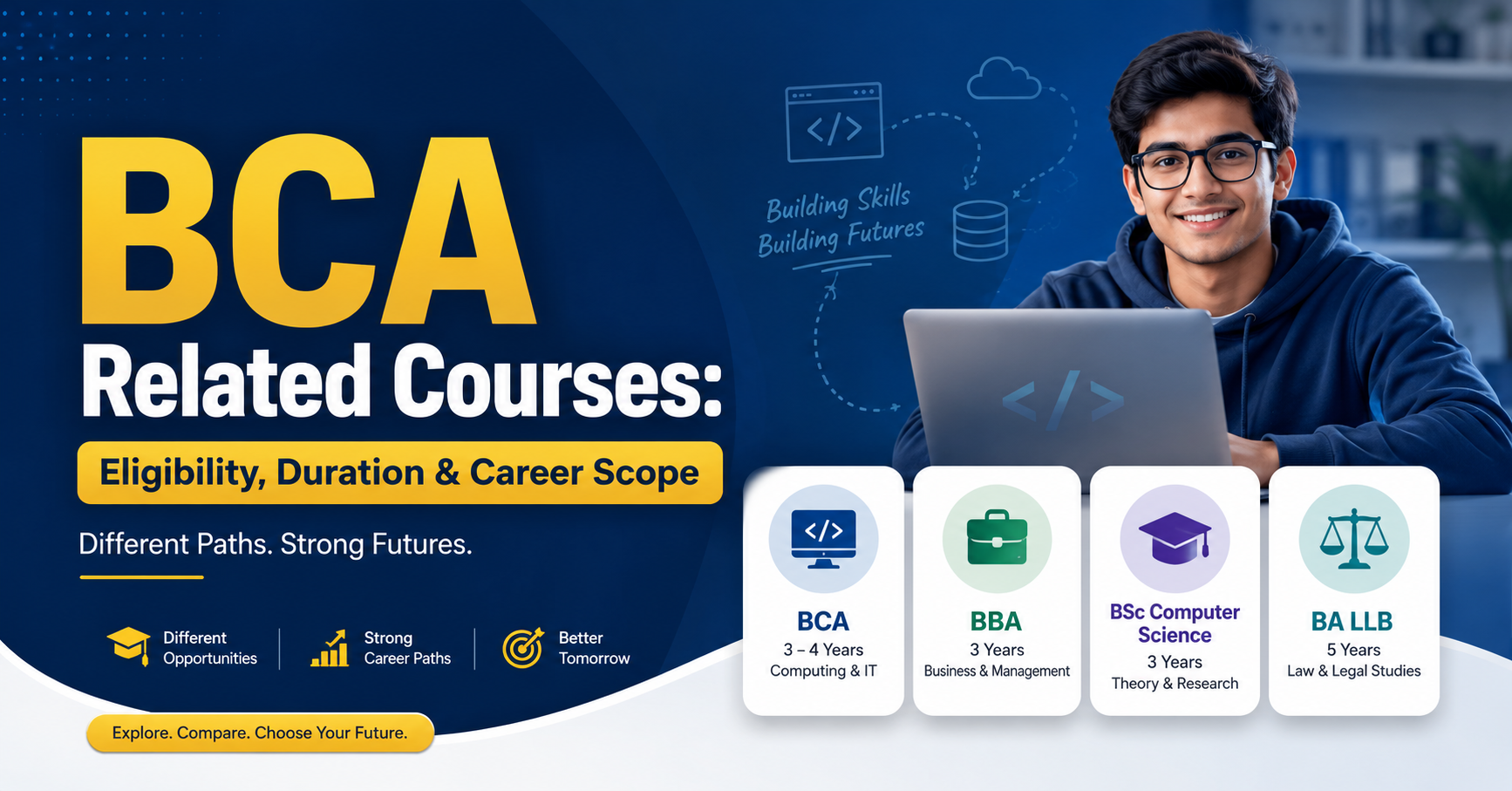
Most students searching for a BCA course aren’t completely sure they want to pursue BCA. They simply want a professional degree after Class 12 that doesn’t require PCM, doesn’t take five years like engineering, and leads to strong career opportunities. BCA is one option—but several other courses also meet these criteria.
The most popular alternatives include BCA (3–4 years, computing), BBA (3 years, management), BSc Computer Science (3 years, theory-focused), and, for students willing to commit to a longer programme, BA LLB (5 years, law). All these courses accept students who have completed 10+2 from any stream, with minimum eligibility typically ranging from 45% to 60% aggregate marks. The real difference isn’t in the eligibility criteria—it’s in the skills you’ll develop and the career you’ll build by the time you’re 25. Here’s a comparison of the eligibility, duration, and career scope of each course.
Key takeaways
- These courses share an entry point: 10+2, any stream, no entrance exam at most private universities. The differences are all downstream.
- Maths in Class 12 is preferred for BCA and irrelevant for BBA and BA LLB. That one subject narrows your options more than your percentage does.
- BCA now runs four years under NEP with multiple exit points, so the old three-year assumption is outdated.
- BA LLB is the longest at five years, but it’s one degree instead of two, and you can practise at 23.
- Specialisation tracks inside BCA and BBA have become the real differentiator, not the base degree.
Eligibility: who qualifies for what
BCA, 10+2 from any stream with 45–50% aggregate. Most decent universities prefer or require Mathematics or Computer Science as a Class 12 subject; some run a foundation module for students without it. Admission is usually merit-based or via a university test.
BBA, 10+2 from any stream. The bar runs 45–60% depending on the university, and some set subject-wise minimums on top (Adamas, for instance, asks 50% in Class 10 and 60% in 10+2 with 45% in each subject, stricter than the sector norm). No maths requirement.
BSc Computer Science, science stream with Mathematics, around 50%. The narrowest gate of the four, because the Maths requirement is firm rather than preferred.
BA LLB, 10+2 from any stream, 45% aggregate (40% for SC/ST). No age limit. The non-negotiable condition is different here: the college must be approved by the Bar Council of India, or the degree won’t let you practise. Admission runs on CLAT, LSAT India or a university test.
Duration: three years, four, or five
BCA is three years across six semesters, or four under the NEP honours-with-research structure with multiple exit options, certificate at one year, diploma at two, degree at three. That flexibility means a change of mind doesn’t cost you the whole investment.
BBA and BSc CS both run three years, with four-year honours versions increasingly common under NEP.
BA LLB is five years. That’s the real trade-off: longer upfront, but it replaces the graduation-then-LLB sequence that takes six, and you’re eligible to practise at 23 rather than 24.
Worth modelling honestly: BCA plus MCA is a five-year plan, same as BA LLB. BBA plus MBA is five too. Almost nobody stops at the bachelor’s in these fields, so compare five-year totals rather than three-year fees.
Compare them side by side
|
BCA |
BBA |
BSc CS |
BA LLB |
|
|
Duration |
3–4 years |
3 years |
3–4 years |
5 years |
|
Class 12 stream |
Any (Maths/CS preferred) |
Any |
Science with Maths |
Any |
|
Minimum marks |
45–50% |
45–60% |
~50% |
45% (40% SC/ST) |
|
Entrance |
Merit/university test |
Merit/university test |
Merit |
CLAT / LSAT / university test |
|
The usual next step |
MCA |
MBA |
MSc / MCA |
LLM or practice |
|
Real question it answers |
Do I want to build software? |
Do I want to run a business? |
Do I want depth and research? |
Do I want to practise law? |
Career scope: where each one leads
After BCA, a software developer, a web developer, a data analyst, a system administrator, QA engineer. Entry salaries run ₹3–8 LPA, and the spread tracks your specialisation and portfolio rather than your marks. Cyber security, data analytics and gaming tracks narrow the field and pay better. MCA later gives you a credential that the market treats as B.Tech-equivalent.
After BBA, sales, marketing, operations, HR and analyst functions, at ₹3–6 LPA to start. The specialisation decides the trajectory: Business Analytics points at data roles, Digital Marketing at performance marketing and content strategy, Logistics at supply chain. MBA is the near-universal next step.
After BSc CS, closer to research and postgraduate study than to immediate employment. MSc, MCA or a data science track. Choose it if depth interests you more than speed to a developer job.
After BA LLB, litigation, corporate law, judiciary preparation, legal advisory, and compliance. Earnings vary more than in any other option here; a first-year litigator and a first-year corporate associate live in different economies. B.A LLB leans toward litigation and civil services; BBA LLB grounds you in corporate law.
The mistakes that cost people years
- Picking BCA as a B.Tech consolation prize. It’s a different degree with a different market position, not a lesser engineering. Students who enrol resentfully tend to coast.
- Ignoring the Maths question. Skip it in Class 12, and BSc CS closes, BCA narrows, and MCA later gets complicated.
- Choosing BA LLB as a five-year safety net. It’s the longest programme here and the least forgiving of half-interest.
- Treating the base degree as the product. Nobody hires “a BCA.” They hire someone who can build a thing.
- Not checking recognition. UGC for the university, BCI specifically for law. Five-minute check, catastrophic to skip.
How to choose, step by step
- Write down what you want to be doing at 25, not the job title, the actual daily work. Building things, running things, arguing things, researching things.
- Check your Class 12 subject list against that. Maths present or absent decides more than you’d expect.
- Shortlist two courses, not one. Read both semester grids end-to-end.
- Look at where the students from that specific course at that university landed. Institution-wide placement stats hide everything.
- Confirm recognition, UGC for the university, and BCI for any law programme.
- Compare five-year totals after scholarships, not three-year sticker fees.
- Apply to two if you’re genuinely torn. Deciding with two offers beats deciding on a hunch in March.
Worth knowing before you apply
- The specialisation is the decision, not the degree. BCA in Cyber Security and BCA in Gaming lead to different lives. Same with BBA in Business Analytics versus Digital Marketing. Choose at that resolution.
- If you pick BCA, learn one thing outside the syllabus every year. The curriculum gives you the base; GitHub gives you the interview.
- For BBA, the internship matters more than the CGPA. Nobody can see management ability until you’ve done the work somewhere.
- Universities running several of these courses under one roof make switching or adding later less painful, worth weighing if you’re undecided at 17.
- Don’t optimise for the highest advertised salary. Optimise for work you won’t resent at 25, then get good enough that the salary follows.
Choosing between these courses at Adamas University, Kolkata
Students comparing BCA colleges in Kolkata often end up choosing between departments rather than universities, which is where Adamas University is worth a look; it runs this entire cluster on one Barasat campus. That includes BCA under the NEP four-year structure with Gaming & Animation and BFSI tracks, BBA with Business Analytics and Digital Marketing specialisations, B.A. LL.B (Hons.) through the School of Law & Justice, and MCA for the postgraduate step. The practical benefit: if you’re torn between two of these at 17, you can compare curricula, faculty and fees in one admissions conversation instead of three. Scholarships for 2026-27 are linked to entrance performance across programmes.
Conclusion
These courses look similar at the entry gate and diverge completely by 25. That’s the thing to understand. Eligibility bars are near-identical, fee ranges overlap, and any of them will admit you, so the filter has to be your own honest answer about what you want to spend your twenties doing.
If you’re comparing BCA, BBA or BA LLB admission in Kolkata for the 2026 session, apply to Adamas University or call 1800-419-7423 and ask the admissions team to walk you through two courses side by side before this intake closes.
FAQs
Which is better, BCA or BBA?
Neither, in the abstract. BCA suits students who want to build software and end up in IT; BBA suits those drawn to how organisations operate. Same duration, same accessibility, entirely different daily work. Choose on the work, not the salary averages.
Can I do BCA without Maths in Class 12?
At several universities, yes, BCA accepts any stream. But many good programmes prefer or require Maths or Computer Science, and skipping it complicates an MCA later. Some universities offer a first-semester foundation module to bridge the gap.
Is BA LLB harder than BCA or BBA?
Longer rather than harder. Five years against three, with heavy reading, moot courts and internships throughout. The real difficulty is commitment: deciding on a career at 17 with less room to change course.
Can I switch from BCA to MCA or BBA to MBA later?
Yes, and both are the standard progression. Neither requires you to have planned it from day one, though Maths eligibility for MCA is worth checking early.
Which of these courses has the best scope?
All four have live demand; they point to different sectors. IT hiring favours BCA graduates who specialised and built projects. Management and analytics roles favour a BBA with a specialisation. Law is its own economy. The scope is decided by what you do inside the degree far more than by which one you pick.
BBA Business Analytics Course: Fees, Admission & Salary
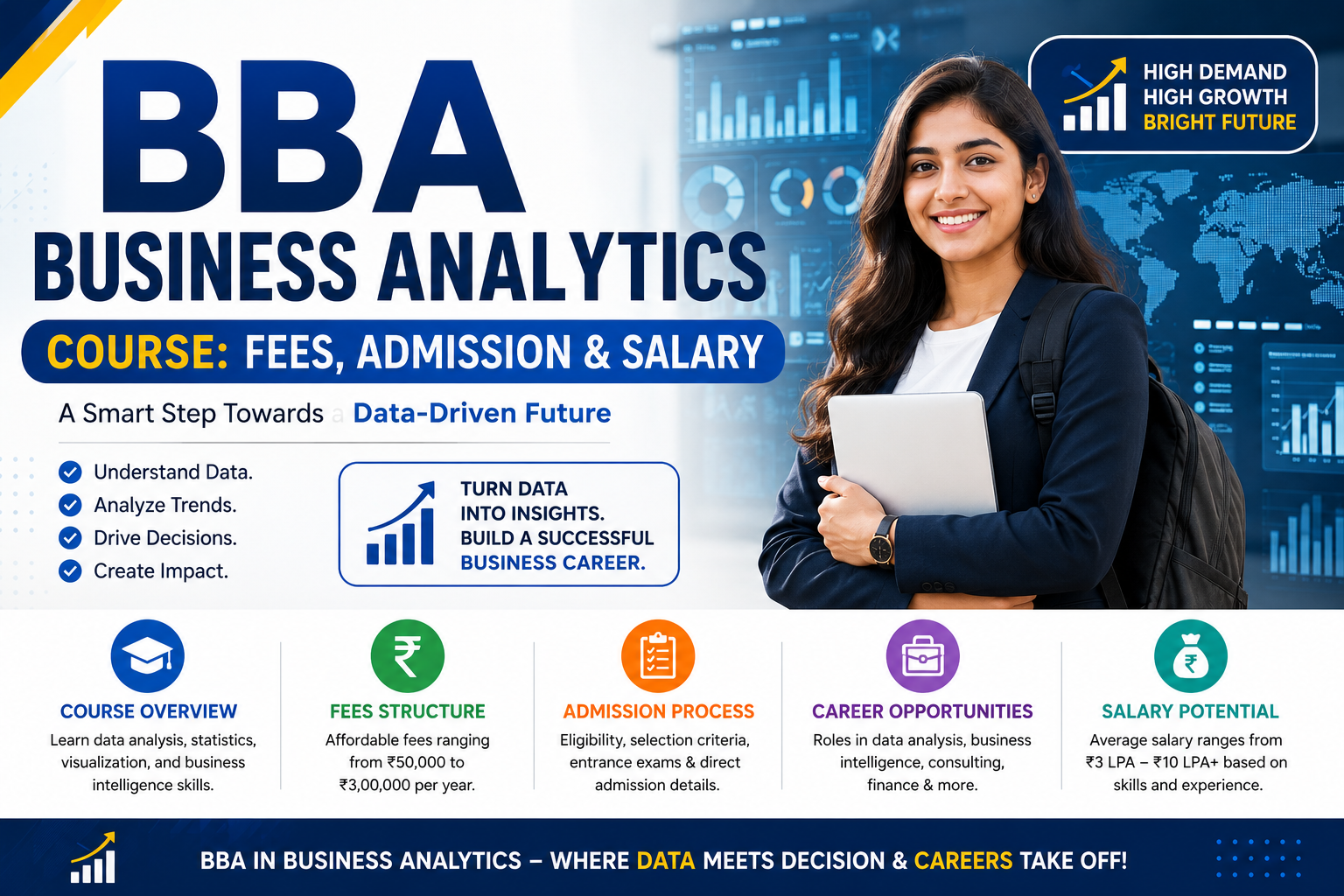
A BBA business analytics course is a three-year undergraduate degree that teaches you to read business problems through data, statistics, visualisation, predictive modelling and BI tools, wrapped around a standard management curriculum. Admission needs 10+2 from any stream, usually 50% aggregate. Fees run from ₹1–5 lakh for the full programme. Freshers earn ₹4–7 LPA, rising to ₹6–12 LPA for analytics and consulting roles.
Why it’s worth looking at: the ManpowerGroup 2026 Talent Shortage Survey puts analytics and IT skills among the top three skill clusters that Indian employers can’t fill. This degree points straight at that gap. Fees, admission and salary are broken out separately below.
Key takeaways
- Three years, six semesters, open to Science, Commerce and Arts students. No engineering background needed.
- The syllabus is genuinely different from a general BBA, Business Statistics, Data Visualisation, Predictive Analytics, and Business Intelligence.
- BBA Business Analytics in India feeds a real hiring corridor: IT and consulting, BFSI, e-commerce, retail, healthcare analytics, telecom.
- Tools matter as much as marks. Excel, SQL, Power BI, Tableau, Python or R, recruiters filter on these.
- Most graduates start as Business Analysts or Data Analysts. MBA or a specialised PG is the usual next step.
What you actually study
Half business, half data, and the interesting bit is where they meet.
The management core stays: financial management, marketing, organisational behaviour, economics. Then the analytics layer goes on top, Business Statistics early, then Data Visualisation, Predictive Analytics, Business Forecasting, and usually a Machine Learning or Big Data introduction later. Marketing Analytics and Financial Analytics apply the toolkit to specific functions.
The point isn’t to make you a data scientist. It’s to make you the person who can look at a dashboard, spot what it’s actually saying, and turn that into a business decision. That translation job is the degree, and it’s why the management subjects stay rather than getting dropped for more maths.
Hands-on work runs throughout, including Excel and R, dashboards, case studies, and a capstone. A programme with no project portfolio at the end isn’t teaching this properly.
BBA vs BBA Business Analytics vs BCA
|
General BBA |
BBA Business Analytics |
BCA |
|
|
Focus |
Broad management |
Management + data decision-making |
Programming and software |
|
Eligibility |
10+2 any stream |
10+2 any stream, ~50% |
10+2, Maths/CS preferred |
|
Core skills |
Marketing, finance, HR |
Statistics, visualisation, BI tools |
Coding, databases, systems |
|
Entry roles |
Sales, marketing exec |
Business analyst, data analyst, MIS analyst |
Developer, system admin |
|
Entry salary |
₹3–6 LPA |
₹4–7 LPA (₹6–12 at top end) |
₹3–8 LPA |
|
Next step |
MBA |
MBA (Analytics) or PG in data science |
MCA |
Fees: what the course costs
|
College type |
Total programme fee |
Per year |
|
Government/state university |
₹30,000–1,00,000 |
₹10,000–35,000 |
|
Mid-range private university |
₹1,20,000–2,50,000 |
₹40,000–85,000 |
|
Top-tier private |
₹2,50,000–5,00,000 |
₹85,000–1,70,000 |
The spread is the problem. The same course name costs ₹1 lakh at one university, and ₹5 lakh at another, and the difference is supposed to be labs, faculty and placements. Verify that it actually is before paying the premium.
Two practical notes. Entrance-linked scholarships at private universities change the real number substantially, so compare after waivers rather than on sticker price. And factor in what you’ll spend outside the fee: certifications, a decent laptop, and occasionally paid tool licences. Budget a little beyond tuition.
Admission: the process, step by step
Eligibility is 10+2 from any recognised board, generally 50%+ aggregate. Some universities set subject-wise minimums as well, so read the fine print before assuming you qualify. Maths in Class 12 helps with the statistics papers, but it isn’t mandatory at most institutions.
Admission route varies: most private universities admit on Class 12 merit or their own entrance test; some accept CUET. A few ask for a statement of purpose or a short interview.
The sequence:
- Confirm eligibility against the specific university’s criteria, including any subject-wise minimum.
- Shortlist on the semester-wise course grid, not the brochure. Check for named tools and a capstone project.
- Register on the university portal and fill out the application.
- Keep documents scanned and ready: 10th and 12th marksheets, photo, signature, ID, category certificate, where applicable.
- Sit the entrance test or interview where required.
- Compare offers after scholarships, then complete document verification and pay to lock the seat.
Deadlines cluster between May and July for the autumn session, and merit rounds close earlier than most applicants expect.
Salary: what graduates actually earn
|
Role |
Entry-level (₹ LPA) |
With 3–5 years |
|
Data Analyst |
4–6 |
8–12 |
|
Business Analyst |
4–7 |
9–14 |
|
MIS Analyst |
3.5–5 |
6–9 |
|
Analytics roles at consulting firms |
6–12 |
12–20+ |
The averages hide what actually moves the number. Tool proficiency and a project portfolio decide where inside a band you land; a graduate with three dashboard projects and SQL fluency starts meaningfully above one with a better CGPA and neither. City matters too: metro postings pay well above the national average for identical roles.
The reason the ceiling is high is structural. Analytics roles attach to revenue decisions, and work that visibly moves revenue gets paid for. That’s also why the field rewards specialisation by year three rather than staying a generalist.
Why students pick it over a general BBA
Specificity. A general BBA graduate and a BBA Business Analytics graduate apply for the same first job; only one of them can open a dataset and say something useful. In a market where the analytics shortage is documented rather than rumoured, that’s a measurable edge.
You also learn the tools while young. Excel, SQL and a BI platform are learnable at 19 with time to build projects, and they stay useful whether you end up in marketing, finance or operations. Even if you never take an analyst title, the literacy compounds.
What’s difficult about it
- The maths is real. Not engineering-level, but Business Statistics arrives in year one and doesn’t leave. If numbers genuinely frighten you, a general BBA will be a happier three years.
- Programme quality varies wildly. Some universities relabelled a general BBA, added two analytics papers and raised the fee. If the course grid names no tools, be suspicious.
- The degree alone doesn’t hire you. Recruiters ask what you’ve built every time.
- It’s an undergraduate degree in a field that often wants postgraduate depth. Plan for an MBA or PG eventually, rather than being surprised by it.
What actually gets you hired
- Learn SQL early, on your own, in year one. It’s the most-requested skill in analyst job posts, and most curricula reach it late.
- Build in public. Three real projects, a sales dashboard, a churn analysis, and something off a public dataset do more for placement than any elective choice.
- Pick your internship for the data, not the brand name. A small company handing you their actual messy sales data teaches more than a big firm handing you slides to format.
- Don’t skip the management subjects to focus on tools. People who plateau in analytics are usually the ones who can query but can’t argue a recommendation to a room.
Studying business analytics at Adamas University, Kolkata
For students comparing BBA colleges in Kolkata and West Bengal, the School of Business & Economics at Adamas University runs its BBA in Business Analytics around case studies and workshop-based teaching rather than lecture-only delivery. Two points from their own published data: the BBA programme reports an 87.5% placement rate, with the remaining students moving to MBA study, and listed recruiters include Aditya Birla Finance, TATA AIG General Insurance and Experis IT. The university also runs an MBA in Business Analytics delivered with SAS as an industry partner, relevant if you’re already thinking about the postgraduate step this field usually calls for. Scholarships for 2026-27 are linked to entrance performance.
Conclusion
A BBA in Business Analytics is a good bet if you like business but want proof behind your arguments, and a bad one if you’re hoping the word “analytics” on a certificate does the work. The degree gives you the vocabulary and the tools. The projects, the internship and the SQL you taught yourself get you hired.
If you’re considering a BBA Business Analytics course in Kolkata for the 2026 session, apply to Adamas University or call 1800-419-7423 to ask about the semester structure and placement record before this intake closes.
FAQs
Can commerce or arts students do a BBA in Business Analytics?
Yes. The course accepts 10+2 from any stream. Maths in Class 12 helps with the statistics papers, but isn’t mandatory at most universities. Willingness to work with numbers for three years matters more.
What is the difference between BBA and BBA Business Analytics?
A general BBA gives broad management grounding. The analytics specialisation keeps that core and adds statistics, data visualisation, predictive analytics and BI tools, aimed at data-driven decision roles. Same duration, different exit profile.
What are the fees for BBA Business Analytics?
Roughly ₹30,000–1 lakh total at government and state universities, ₹1.2–2.5 lakh at mid-range private universities, and up to ₹5 lakh at top-tier private institutions. Entrance-linked scholarships can cut the private figure considerably.
What is the salary after a BBA in Business Analytics?
Entry-level roles typically pay ₹4–7 LPA, with analytics and consulting positions reaching ₹6–12 LPA. Three to five years in, Business Analysts commonly reach ₹9–14 LPA. Tool skills and a project portfolio move the number more than the degree does.
Do I need an MBA after a BBA in Business Analytics?
Not immediately, but most people get there. The undergraduate degree opens analyst roles; the MBA or a specialised PG typically opens the managerial layer above. Two or three years of work first usually makes the PG more valuable.
BCA vs MCA: Eligibility, Fees, Duration, Salary & Career Comparison
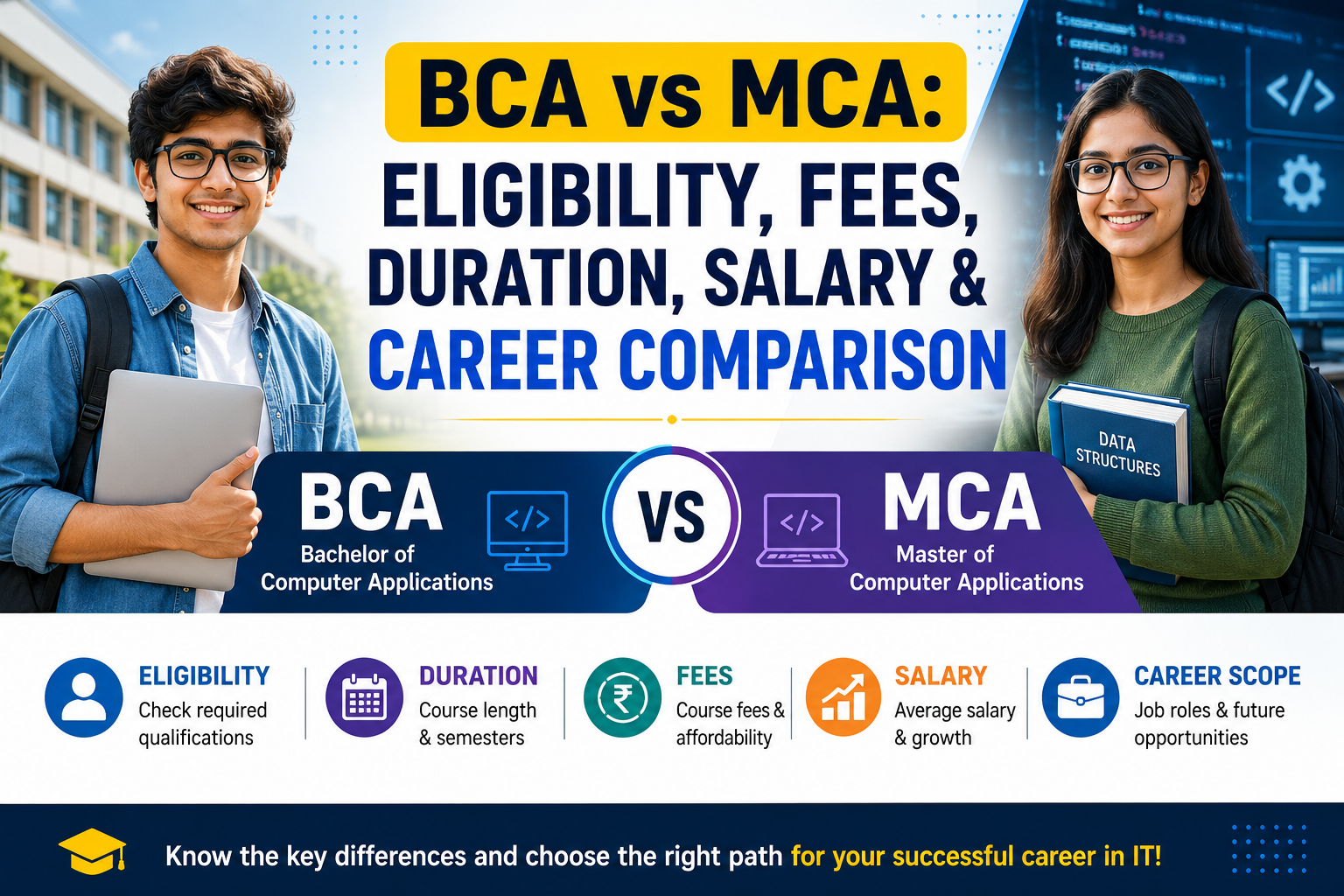
BCA and MCA aren’t rivals. They’re a sequence.
BCA is the three-year undergraduate degree you take after Class 12. MCA is a two-year postgraduate degree that you take after it. Asking which is better is a bit like asking whether Class 10 beats Class 12. The real question is whether you stop after the BCA course and start earning, or spend two more years and enter at a different level.
Money makes the case plain. BCA freshers start around ₹3–8 LPA. MCA graduates average ₹7–10 LPA, with experienced professionals crossing ₹20 LPA. Below: eligibility, duration, fees, salary and career paths for each, separately.
Key takeaways
- BCA: 3 years after 10+2, any stream, 45–50%. Four years under the NEP honours route.
- MCA: 2 years after graduation. UGC cut it from three years to two in 2020; most blogs still get this wrong.
- Fees overlap more than people assume: BCA ₹10,000–3 lakh a year, MCA ₹20,000–2 lakh.
- Jobs after BCA : developer, web developer, data analyst. MCA is what unlocks architecture and senior engineering roles.
- You don’t need a BCA to do an MCA. BSc and B.Tech graduates qualify; Class 12 Maths is the usual hard requirement.
BCA vs MCA at a glance
|
BCA |
MCA |
|
|
Level |
Undergraduate |
Postgraduate |
|
Duration |
3 years (4 under NEP honours) |
2 years |
|
Eligibility |
10+2, any stream, 45–50% |
Graduation with Maths, ~50% |
|
Entrance |
Merit or university test |
CUET PG, NIMCET, TANCET, university test |
|
Annual fees |
₹10,000–3,00,000 |
₹20,000–2,00,000 |
|
Fresher salary |
₹3–8 LPA |
₹4–12 LPA (avg 7–10) |
|
Entry roles |
Web developer, junior developer, data analyst |
Software engineer, system analyst, cloud engineer |
Eligibility: who can apply
For BCA, you need 10+2 from a recognised board with 45–50% aggregate. Any stream, Science, Commerce or Arts. Most good universities prefer Mathematics or Computer Science as a Class 12 subject, and some insist on it. A few run a foundation module for students who arrive without it.
For MCA, you need a bachelor’s degree with roughly 50%. BCA is the natural feeder, but BSc (IT/Computer Science), B.Tech and other graduates qualify at most universities. The condition that catches people is Mathematics, usually required at the Class 12 or graduation level. Candidates from non-computing backgrounds may need a bridge module in semester one.
Admission routes differ, too. BCA is mostly merit-based or via a university test. MCA runs through CUET PG, NIMCET, TANCET or an institutional exam, depending on where you apply.
Duration: three years, then two
BCA runs for three years across six semesters. Under NEP 2020, many universities now offer a four-year honours-with-research version with multiple exit points, a certificate at one year, diploma at two, degree at three. That structure also creates a smoother bridge into postgraduate study abroad, which the three-year version never had.
MCA is two years, four semesters. This is the detail most sources still get wrong: UGC reduced it from three years to two back in 2020. If an article tells you three, it’s outdated, and the error distorts the entire cost calculation.
Total run for both: five years. Same as an integrated law degree, one year more than B.Tech.
Fees: what each actually costs
|
College type |
BCA (per year) |
MCA (per year) |
|
Government / aided |
₹10,000–40,000 |
₹20,000–50,000 |
|
Private university |
₹80,000–3,00,000 |
₹60,000–2,00,000 |
|
Typical mid-range |
₹60,000–1,20,000 |
₹50,000–1,00,000 |
Two things worth noticing. First, MCA is often cheaper per year than BCA at private universities, which surprises people, postgraduate programmes carry lower headcounts and less marketing overhead. Second, the honest number is the five-year total, not the annual fee. Model BCA plus MCA as one investment, because that’s how you’ll actually pay it.
Entrance-linked scholarships change the real figure at private universities, sometimes substantially. Compare after waivers, not on sticker price.
Salary: what the gap really looks like
BCA freshers land ₹3–8 LPA. The spread is wide because it tracks skills, not the degree, a graduate with a project portfolio and cloud certifications sits at the top of that band, one with neither sits at the bottom.
MCA graduates average ₹7–10 LPA, with freshers at ₹4–8 LPA and experienced professionals crossing ₹20 LPA. The premium comes from role access rather than the certificate itself: MCA opens engineering and architecture positions that BCA-only candidates rarely get shortlisted for.
The caveat matters. These are national averages across cities, roles and company types. A Kolkata support role and a Bengaluru product role live at opposite ends of the same number, and skills move you further within a band than the degree moves you between bands.
Career paths: after BCA and after MCA
After BCA: software developer, web developer, data analyst, system administrator, QA engineer. With a specialisation, cyber security, data analytics, and gaming, those tracks narrow and pay better. It’s a genuine three-year route into IT employment, which is the whole point of the degree.
After MCA: software engineer, system analyst, cloud engineer, data scientist, IT consultant. MCA is broadly treated as B.Tech-equivalent for hiring and for government job eligibility, which is precisely why BCA graduates return for it. Product companies hiring architects, government IT posts specifying a PG qualification, and teaching positions all filter on it.
The ceiling is the honest reason people go back. Two or three years into a junior role, promotions start going to postgraduates and engineering backgrounds, and the limit stops being theoretical.
Where students get this wrong
- Treating it as either/or. Most MCA students did a BCA first. The real decision is when, straight through, or after work experience.
- Assuming MCA is still three years. UGC changed it in 2020, and the outdated number wrecks the cost-benefit maths.
- Ignoring the Maths requirement. A BCA student who dodged maths modules can hit a wall at MCA admission.
- Chasing the cheapest BCA colleges without checking placements. A ₹40,000 degree leading nowhere costs more than a ₹1.2-lakh one that places you.
- Doing an MCA to postpone job-hunting. Recruiters can tell the difference between a strategic PG and a hiding place.
How to decide, step by step
- Name your target role honestly. Web developer or junior analyst? BCA suffices. Architect, data scientist, government IT officer? You’ll need the MCA eventually.
- Check your Class 12 Maths status now. It determines whether MCA stays open.
- Model total cost across five years, not annual fees.
- Look at placement data by degree, not by college. The gap between a university’s BCA and MCA outcomes tells you what the PG is worth there.
- If you’re mid-BCA, decide in semester five, that’s when CUET PG or NIMCET prep needs to begin.
- Consider working first. Two years of industry experience make MCA coursework stand out, and some employers part-fund it.
Before you decide
- Skills beat a degree tier at the entry level. A BCA graduate with a portfolio out-hires an MCA graduate without one. The degree opens the interview; it doesn’t win it.
- If you’re doing a BCA now, treat the specialisation seriously. Data analytics, cybersecurity and gaming tracks are what recruiters filter on.
- Verify UGC-DEB approval for any online option at either level. An unapproved degree fails government eligibility checks at the worst moment.
- Lateral entry into MCA’s second year exists at several universities, which shortens the detour for eligible candidates.
Studying computer applications at Adamas University, Kolkata
For students comparing BCA colleges in Kolkata and West Bengal, Adamas University runs both ends of this pathway on one Barasat campus, which matters practically, since continuing from BCA into MCA at the same university removes an admission cycle from your plans. The BCA follows the NEP four-year structure with multiple exit points and tracks, including Gaming & Animation and BFSI; the MCA runs the standard two-year format. Admission works on standard eligibility through multiple routes, and scholarships for 2026-27 are tied to entrance performance rather than board marks alone.
Conclusion
Stop framing this as BCA versus MCA. Frame it as: do I enter the industry at 21 and possibly return at 25, or plan the five-year run now? Both answers are defensible. The one that isn’t is drifting into an MCA because the job hunt got hard, or skipping it while quietly wanting the roles it gates.
If you’re weighing up BCA or MCA admission in Kolkata for the 2026 session, apply to Adamas University or call 1800-419-7423 to talk through which entry point fits your target role before this intake closes.
FAQs
Can I do MCA without a BCA?
Yes. BSc (IT/Computer Science), B.Tech and other graduates qualify at most universities, usually with Mathematics at Class 12 or graduation level. Candidates from non-computing backgrounds may need a bridge module in the first semester.
Is MCA still a 3-year course?
No. UGC reduced MCA from three years to two in 2020. It now runs four semesters. Any source saying three years is out of date, and that error meaningfully distorts the cost comparison.
Which pays more, BCA or MCA?
MCA, on average, roughly ₹7–10 LPA against ₹3–8 LPA for BCA freshers. But averages hide a wide spread. Role, city, company type and your actual skills move the number far more than the degree label.
What are the best jobs after BCA?
Software developer, web developer, data analyst, system administrator and QA engineer are the common entry points. With a specialisation and a portfolio, cyber security and cloud roles open up. Senior architecture roles usually wait for an MCA or equivalent experience.
Should I do MCA immediately after BCA or work first?
Both work. Going straight through finishes your education by 23. Working first makes the coursework more meaningful and sometimes gets partly funded. The wrong reason to go straight through is avoiding the job market.
BSc Agriculture Subjects: Complete Syllabus & Semester-Wise Curriculum

The short answer first, because that’s what most people came for. B sc agriculture subjects run across eight semesters and four years, built on the ICAR model curriculum, and they cover far more than crops. You study soil, genetics, pests, economics, farm machinery and biotechnology, with roughly 60% of the marks now tied to practical work rather than theory. The final year barely touches a classroom: it’s village postings and a mini agri-business you run yourself.
That last part surprises people. So does the fact that the B.Sc. Agriculture syllabus has been rebuilt under NEP 2020 and the ICAR Sixth Dean’s Committee, shifting hard toward hands-on training. Here’s the full year-by-year breakdown, plus what the practical components actually involve.
Key takeaways
- Eight semesters, four years, ICAR-standardised, so the core is broadly the same whether you study in Punjab or West Bengal.
- The B.Sc. Agriculture course curriculum now runs a 60:40 practical-to-theory ratio under the latest ICAR/NEP framework.
- Every major subject has a paired theory and practical component. You don’t just read about grafting; you graft.
- Years one and two build fundamentals. Years three and four go specialised, then almost fully practical.
- The final year is RAWE (a 20-week village stay) plus ELP (running a real agri-enterprise). This is the part employers ask about.
How the BSc Agriculture syllabus is structured
Think of the four years as a slope, not four equal blocks. You start with basic science and Indian agricultural heritage, climb into crop production and protection, then into management and entrepreneurship, and finish almost entirely in the field.
The ICAR framework keeps the skeleton consistent across universities. Course titles shift a little; one college’s “Fundamentals of Agronomy” is another’s “Principles of Crop Production”, but the themes and credit structure hold. That consistency is deliberate, and it’s why an ICAR-aligned degree travels well to PG entrance exams and government recruitment alike.
One structural detail that catches PCM students off guard: if you came in without Biology, expect a remedial botany or plant-science module in semester one. It’s a bridge, not a barrier.
Semester-wise subjects
First year (Semesters I & II)
Foundations. You meet the basic sciences and the discipline itself.
- Fundamentals of Agronomy, Soil Science, Genetics, and Plant Biochemistry
- Introductory Biology / remedial botany for maths-stream students
- Agricultural Meteorology, Introduction to Forestry
- Comprehension and communication skills, plus basic agricultural statistics
- Indian agricultural heritage is more interesting than it sounds, and it frames everything after it
Second year (Semesters III & IV)
This is where it gets technical. The bsc agriculture semester wise subjects here move into how crops are actually grown and defended.
- Crop Production (Kharif and Rabi crops), Agronomy of field crops
- Entomology (insect pests) and Plant Pathology (crop diseases)
- Genetics and Plant Breeding, Agricultural Microbiology
- Horticulture – fruit, vegetable and ornamental crops
- Soil fertility, nutrient management and agricultural finance
Third year (Semesters V & VI)
Management, protection and enterprise thinking take over.
- Integrated Pest Management and Pests of Stored Grain
- Farm Management, Production Economics, Agribusiness Management
- Seed Production and Technology, Post-Harvest Management
- Renewable energy, protected cultivation, and often an educational tour
- Elective choices open up here: Mushroom Cultivation, Apiculture, Sericulture, Organic Farming
Fourth year (Semesters VII & VIII)
Almost no lectures. This is the year that makes the degree professional.
- Semester VII – RAWE: the Rural Agricultural Work Experience. A roughly 20-week village and farm attachment where you live near farmers, diagnose real problems and work with farm families. ICAR pays a stipend during it.
- Semester VIII – ELP: the Experiential Learning Programme. You run a mini agri-enterprise end to end, from production to marketing, often something like commercial horticulture or bio-fertiliser production. Attendance rules are strict; enterprises don’t pause for holidays.
Theory vs practical: the weightage that changed
|
Component |
Older ICAR curriculum |
Current (VI Dean’s / NEP 2020) |
|
Practical-to-theory split |
Roughly 40:60 |
Around 60:40 |
|
Final-year focus |
Some internship |
Full RAWE + ELP year |
|
Exit flexibility |
Single degree exit |
Multiple exit (certificate/diploma/degree) |
|
Skill modules |
Limited |
Mandatory skill-based modules |
|
New-tech content |
Sparse |
Agri-informatics, drones, climate-smart farming |
What the practical training actually gives you
Employers in this sector don’t hire on marksheets alone; they hire on whether you’ve handled a real farm problem. That’s the whole logic behind RAWE and ELP.
RAWE puts you in a village for the better part of a semester. You’re not observing — you’re diagnosing crop issues, advising farm families, seeing why a “textbook” recommendation fails on real soil. Students consistently call it the part of the degree that changed how they think.
ELP then flips you from student to operator. Running a mini-enterprise, even a small one, teaches costing, marketing and failure in a way no exam can. When an agri-business recruiter or an IBPS AFO interview panel asks what you’ve actually done, this is the answer that lands.
Common challenges with the curriculum
- The practical load is heavy and non-negotiable. Students who pictured a lecture-hall science degree find the fieldwork exhausting; the ones who came for the fieldwork thrive.
- Syllabi differ in the details between universities, so notes and PDFs from one college won’t map perfectly onto another’s exams. Use your own university’s official syllabus, not a generic download.
- The elective choice in year three quietly shapes your career. Picking Apiculture or Organic Farming on a whim, then wanting an agri-tech job, creates a mismatch you’ll feel at placement.
- RAWE’s village posting can be logistically demanding. Plan for it rather than being surprised by it in the final year.
Expert tips
- Download your target university’s syllabus PDF before admission, not after. It tells you the elective spread and the tech content, which is where good programmes separate from box-tickers.
- Treat RAWE and ELP as your CV, not a formality. Keep a proper daily field log — recruiters and PG interviewers ask for specifics, and a real record beats a vague memory.
- If PG research is the plan, weight your attention toward Genetics, Plant Breeding and Soil Science, and start ICAR JRF/SRF prep from year three rather than year four.
- Check whether your university has actually adopted the VI Dean’s Committee framework. Some are mid-transition, and the practical ratio and multiple-exit options depend on it.
Studying agriculture at Adamas University, Kolkata
For students comparing the syllabus across agriculture colleges in West Bengal, the School of Smart Agriculture at Adamas University runs its B.Sc. (Hons.) Agriculture on the ICAR model, with the practical year built around RAWE and ELP on its Barasat campus near Kolkata. The distinguishing bit is where the “smart” comes in — precision farming, agri-informatics and sustainability modules sit alongside the classical agronomy and plant-breeding core, matching the direction ICAR’s newer curriculum is pushing. Admission runs through multiple routes on standard eligibility, and scholarships for 2026-27 are linked to entrance performance.
Conclusion
The BSc Agriculture syllabus is best understood as a slow handover from classroom to field. Four years, eight semesters, a consistent ICAR core, and a final year that turns theory into village work and a real enterprise. The subject matter, but the practical training, is what the degree is actually selling, and what employers actually buy.
If you’re weighing up the curriculum at agriculture colleges in West Bengal for the 2026 session, apply to Adamas University or call 1800-419-7423 to ask the admissions team how the School of Smart Agriculture runs its practical year before this intake closes.
FAQs
How many subjects are there in each semester of the BSc Agriculture?
Typically, 8 to 11 courses per semester, each usually carrying both a theory and a practical component. The exact count varies by university and by which year you’re in; later semesters lean heavier on practicals.
Is Biology compulsory to study the BSc Agriculture syllabus?
No. Students from both the PCB and PCM streams can take the course. Maths-stream students without Biology usually complete a remedial botany or plant-science module in the first semester to level up.
What is RAWE in the BSc Agriculture curriculum?
RAWE is the Rural Agricultural Work Experience, a roughly 20-week attachment in the final year where students live and work in villages and on farms. It carries a stipend from ICAR and is where most of the degree’s real-world learning happens.
Is the BSc Agriculture syllabus the same at every university?
The core is broadly consistent because it follows the ICAR model curriculum, but course titles, electives and the exact credit split differ between state, central and private universities. Always study your own institution’s official syllabus.
Which subjects matter most for higher studies after a BSc Agriculture?
For ICAR JRF/SRF and M.Sc entrance, Genetics and Plant Breeding, Soil Science and Agronomy carry the most weight. Students aiming at agri-business lean on the farm management and economics courses in year three.
