

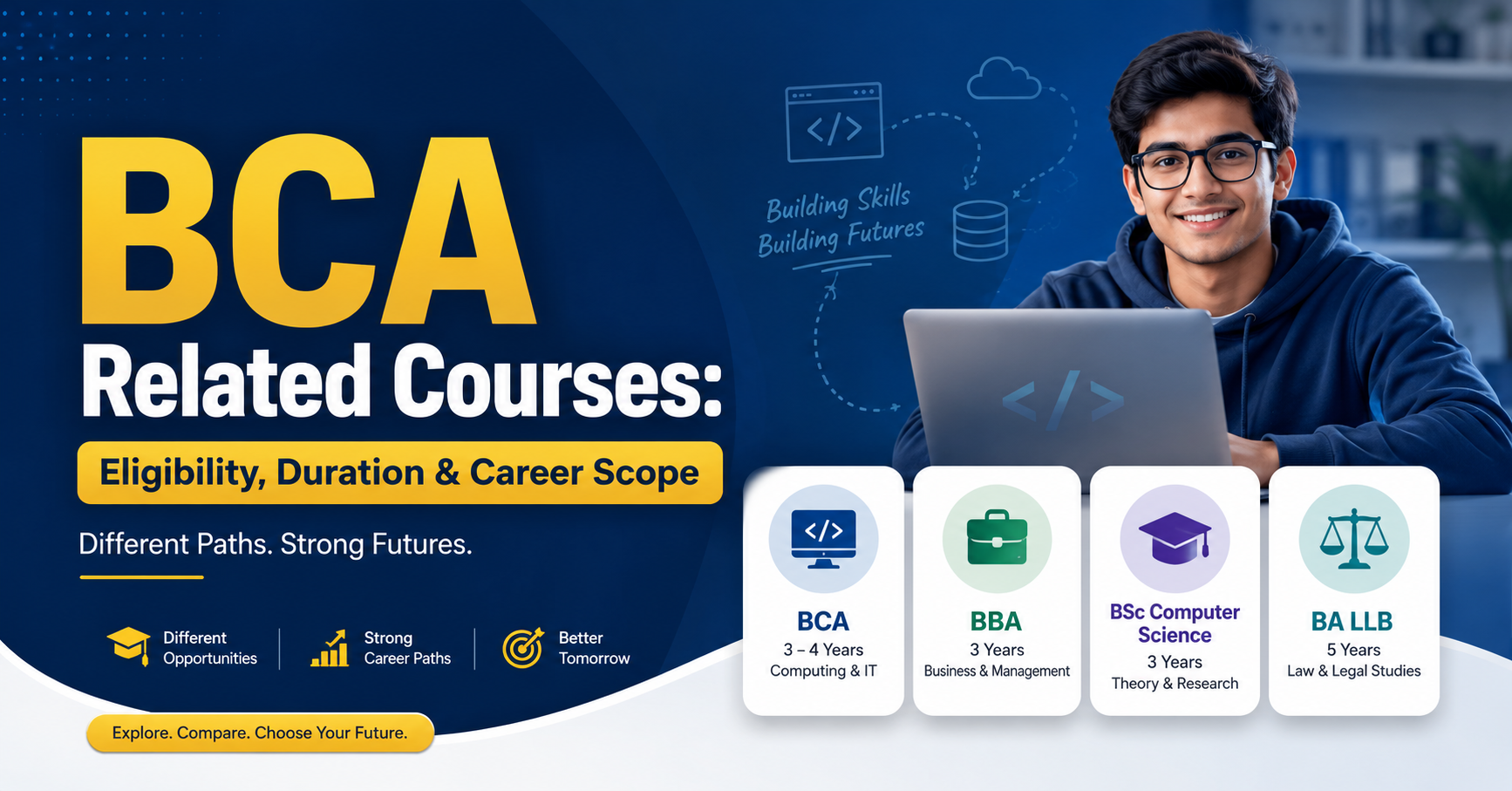
Most students searching for a BCA course aren’t completely sure they want to pursue BCA. They simply want a professional degree after Class 12 that doesn’t require PCM, doesn’t take five years like engineering, and leads to strong career opportunities. BCA is one option—but several other courses also meet these criteria.
The most popular alternatives include BCA (3–4 years, computing), BBA (3 years, management), BSc Computer Science (3 years, theory-focused), and, for students willing to commit to a longer programme, BA LLB (5 years, law). All these courses accept students who have completed 10+2 from any stream, with minimum eligibility typically ranging from 45% to 60% aggregate marks. The real difference isn’t in the eligibility criteria—it’s in the skills you’ll develop and the career you’ll build by the time you’re 25. Here’s a comparison of the eligibility, duration, and career scope of each course.
Key takeaways
- These courses share an entry point: 10+2, any stream, no entrance exam at most private universities. The differences are all downstream.
- Maths in Class 12 is preferred for BCA and irrelevant for BBA and BA LLB. That one subject narrows your options more than your percentage does.
- BCA now runs four years under NEP with multiple exit points, so the old three-year assumption is outdated.
- BA LLB is the longest at five years, but it’s one degree instead of two, and you can practise at 23.
- Specialisation tracks inside BCA and BBA have become the real differentiator, not the base degree.
Eligibility: who qualifies for what
BCA, 10+2 from any stream with 45–50% aggregate. Most decent universities prefer or require Mathematics or Computer Science as a Class 12 subject; some run a foundation module for students without it. Admission is usually merit-based or via a university test.
BBA, 10+2 from any stream. The bar runs 45–60% depending on the university, and some set subject-wise minimums on top (Adamas, for instance, asks 50% in Class 10 and 60% in 10+2 with 45% in each subject, stricter than the sector norm). No maths requirement.
BSc Computer Science, science stream with Mathematics, around 50%. The narrowest gate of the four, because the Maths requirement is firm rather than preferred.
BA LLB, 10+2 from any stream, 45% aggregate (40% for SC/ST). No age limit. The non-negotiable condition is different here: the college must be approved by the Bar Council of India, or the degree won’t let you practise. Admission runs on CLAT, LSAT India or a university test.
Duration: three years, four, or five
BCA is three years across six semesters, or four under the NEP honours-with-research structure with multiple exit options, certificate at one year, diploma at two, degree at three. That flexibility means a change of mind doesn’t cost you the whole investment.
BBA and BSc CS both run three years, with four-year honours versions increasingly common under NEP.
BA LLB is five years. That’s the real trade-off: longer upfront, but it replaces the graduation-then-LLB sequence that takes six, and you’re eligible to practise at 23 rather than 24.
Worth modelling honestly: BCA plus MCA is a five-year plan, same as BA LLB. BBA plus MBA is five too. Almost nobody stops at the bachelor’s in these fields, so compare five-year totals rather than three-year fees.
Compare them side by side
|
BCA |
BBA |
BSc CS |
BA LLB |
|
|
Duration |
3–4 years |
3 years |
3–4 years |
5 years |
|
Class 12 stream |
Any (Maths/CS preferred) |
Any |
Science with Maths |
Any |
|
Minimum marks |
45–50% |
45–60% |
~50% |
45% (40% SC/ST) |
|
Entrance |
Merit/university test |
Merit/university test |
Merit |
CLAT / LSAT / university test |
|
The usual next step |
MCA |
MBA |
MSc / MCA |
LLM or practice |
|
Real question it answers |
Do I want to build software? |
Do I want to run a business? |
Do I want depth and research? |
Do I want to practise law? |
Career scope: where each one leads
After BCA, a software developer, a web developer, a data analyst, a system administrator, QA engineer. Entry salaries run ₹3–8 LPA, and the spread tracks your specialisation and portfolio rather than your marks. Cyber security, data analytics and gaming tracks narrow the field and pay better. MCA later gives you a credential that the market treats as B.Tech-equivalent.
After BBA, sales, marketing, operations, HR and analyst functions, at ₹3–6 LPA to start. The specialisation decides the trajectory: Business Analytics points at data roles, Digital Marketing at performance marketing and content strategy, Logistics at supply chain. MBA is the near-universal next step.
After BSc CS, closer to research and postgraduate study than to immediate employment. MSc, MCA or a data science track. Choose it if depth interests you more than speed to a developer job.
After BA LLB, litigation, corporate law, judiciary preparation, legal advisory, and compliance. Earnings vary more than in any other option here; a first-year litigator and a first-year corporate associate live in different economies. B.A LLB leans toward litigation and civil services; BBA LLB grounds you in corporate law.
The mistakes that cost people years
- Picking BCA as a B.Tech consolation prize. It’s a different degree with a different market position, not a lesser engineering. Students who enrol resentfully tend to coast.
- Ignoring the Maths question. Skip it in Class 12, and BSc CS closes, BCA narrows, and MCA later gets complicated.
- Choosing BA LLB as a five-year safety net. It’s the longest programme here and the least forgiving of half-interest.
- Treating the base degree as the product. Nobody hires “a BCA.” They hire someone who can build a thing.
- Not checking recognition. UGC for the university, BCI specifically for law. Five-minute check, catastrophic to skip.
How to choose, step by step
- Write down what you want to be doing at 25, not the job title, the actual daily work. Building things, running things, arguing things, researching things.
- Check your Class 12 subject list against that. Maths present or absent decides more than you’d expect.
- Shortlist two courses, not one. Read both semester grids end-to-end.
- Look at where the students from that specific course at that university landed. Institution-wide placement stats hide everything.
- Confirm recognition, UGC for the university, and BCI for any law programme.
- Compare five-year totals after scholarships, not three-year sticker fees.
- Apply to two if you’re genuinely torn. Deciding with two offers beats deciding on a hunch in March.
Worth knowing before you apply
- The specialisation is the decision, not the degree. BCA in Cyber Security and BCA in Gaming lead to different lives. Same with BBA in Business Analytics versus Digital Marketing. Choose at that resolution.
- If you pick BCA, learn one thing outside the syllabus every year. The curriculum gives you the base; GitHub gives you the interview.
- For BBA, the internship matters more than the CGPA. Nobody can see management ability until you’ve done the work somewhere.
- Universities running several of these courses under one roof make switching or adding later less painful, worth weighing if you’re undecided at 17.
- Don’t optimise for the highest advertised salary. Optimise for work you won’t resent at 25, then get good enough that the salary follows.
Choosing between these courses at Adamas University, Kolkata
Students comparing BCA colleges in Kolkata often end up choosing between departments rather than universities, which is where Adamas University is worth a look; it runs this entire cluster on one Barasat campus. That includes BCA under the NEP four-year structure with Gaming & Animation and BFSI tracks, BBA with Business Analytics and Digital Marketing specialisations, B.A. LL.B (Hons.) through the School of Law & Justice, and MCA for the postgraduate step. The practical benefit: if you’re torn between two of these at 17, you can compare curricula, faculty and fees in one admissions conversation instead of three. Scholarships for 2026-27 are linked to entrance performance across programmes.
Conclusion
These courses look similar at the entry gate and diverge completely by 25. That’s the thing to understand. Eligibility bars are near-identical, fee ranges overlap, and any of them will admit you, so the filter has to be your own honest answer about what you want to spend your twenties doing.
If you’re comparing BCA, BBA or BA LLB admission in Kolkata for the 2026 session, apply to Adamas University or call 1800-419-7423 and ask the admissions team to walk you through two courses side by side before this intake closes.
FAQs
Which is better, BCA or BBA?
Neither, in the abstract. BCA suits students who want to build software and end up in IT; BBA suits those drawn to how organisations operate. Same duration, same accessibility, entirely different daily work. Choose on the work, not the salary averages.
Can I do BCA without Maths in Class 12?
At several universities, yes, BCA accepts any stream. But many good programmes prefer or require Maths or Computer Science, and skipping it complicates an MCA later. Some universities offer a first-semester foundation module to bridge the gap.
Is BA LLB harder than BCA or BBA?
Longer rather than harder. Five years against three, with heavy reading, moot courts and internships throughout. The real difficulty is commitment: deciding on a career at 17 with less room to change course.
Can I switch from BCA to MCA or BBA to MBA later?
Yes, and both are the standard progression. Neither requires you to have planned it from day one, though Maths eligibility for MCA is worth checking early.
Which of these courses has the best scope?
All four have live demand; they point to different sectors. IT hiring favours BCA graduates who specialised and built projects. Management and analytics roles favour a BBA with a specialisation. Law is its own economy. The scope is decided by what you do inside the degree far more than by which one you pick.
Visited 2214 times, 2 Visits today

