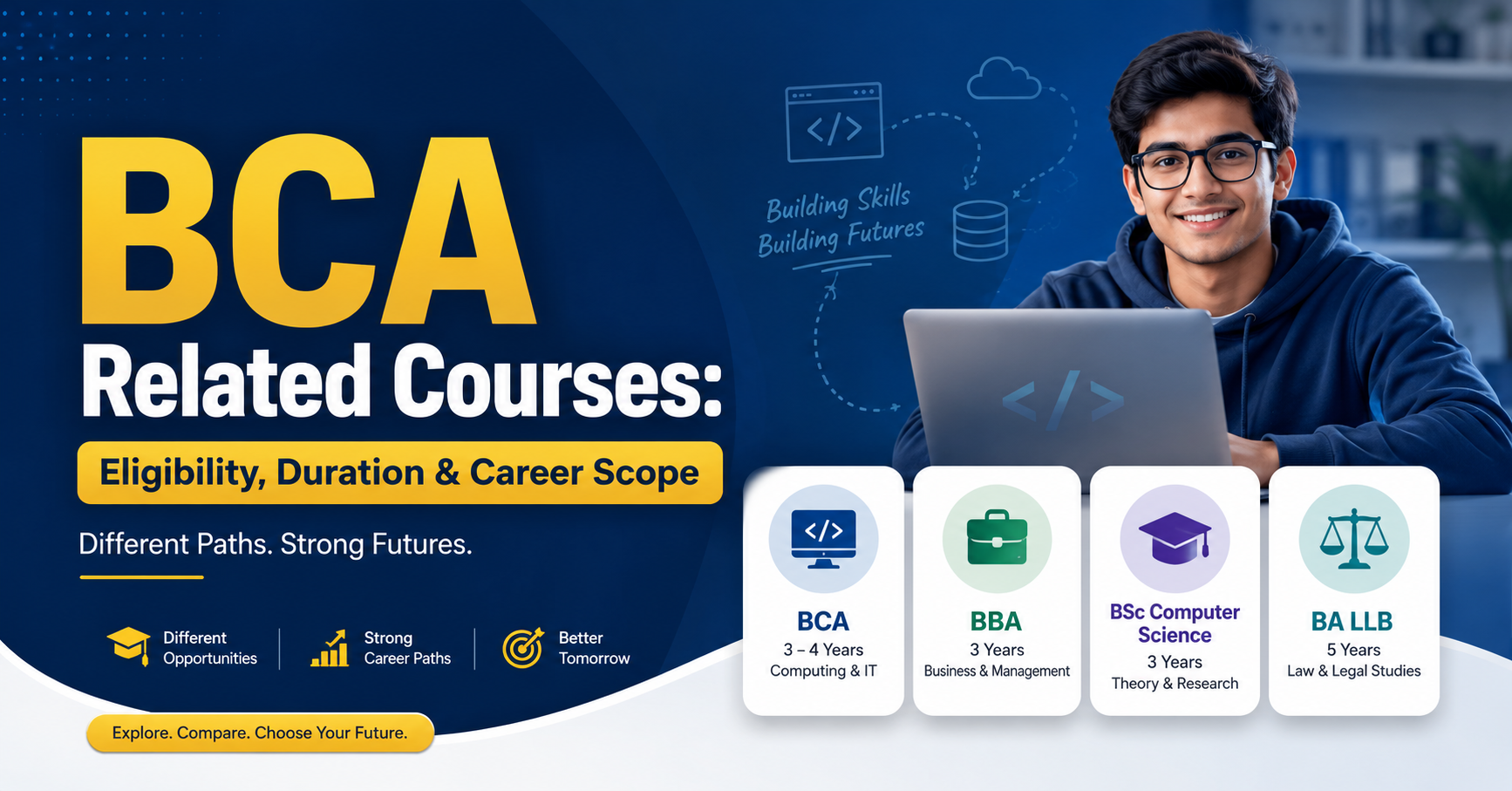
BCA Related Courses: Eligibility, Duration & Career Scope

Most students searching for a BCA course aren’t completely sure they want to pursue BCA. They simply want a professional degree after Class 12 that doesn’t require PCM, doesn’t take five years like engineering, and leads to strong career opportunities. BCA is one option—but several other courses also meet these criteria.

The most popular alternatives include BCA (3–4 years, computing), BBA (3 years, management), BSc Computer Science (3 years, theory-focused), and, for students willing to commit to a longer programme, BA LLB (5 years, law). All these courses accept students who have completed 10+2 from any stream, with minimum eligibility typically ranging from 45% to 60% aggregate marks. The real difference isn’t in the eligibility criteria—it’s in the skills you’ll develop and the career you’ll build by the time you’re 25. Here’s a comparison of the eligibility, duration, and career scope of each course.

Key takeaways 

  • These courses share an entry point: 10+2, any stream, no entrance exam at most private universities. The differences are all downstream.
  • Maths in Class 12 is preferred for BCA and irrelevant for BBA and BA LLB. That one subject narrows your options more than your percentage does.
  • BCA now runs four years under NEP with multiple exit points, so the old three-year assumption is outdated.
  • BA LLB is the longest at five years, but it’s one degree instead of two, and you can practise at 23.
  • Specialisation tracks inside BCA and BBA have become the real differentiator, not the base degree.

Eligibility: who qualifies for what 

BCA, 10+2 from any stream with 45–50% aggregate. Most decent universities prefer or require Mathematics or Computer Science as a Class 12 subject; some run a foundation module for students without it. Admission is usually merit-based or via a university test.

BBA, 10+2 from any stream. The bar runs 45–60% depending on the university, and some set subject-wise minimums on top (Adamas, for instance, asks 50% in Class 10 and 60% in 10+2 with 45% in each subject, stricter than the sector norm). No maths requirement.

BSc Computer Science, science stream with Mathematics, around 50%. The narrowest gate of the four, because the Maths requirement is firm rather than preferred.

BA LLB, 10+2 from any stream, 45% aggregate (40% for SC/ST). No age limit. The non-negotiable condition is different here: the college must be approved by the Bar Council of India, or the degree won’t let you practise. Admission runs on CLAT, LSAT India or a university test.

Duration: three years, four, or five 

BCA is three years across six semesters, or four under the NEP honours-with-research structure with multiple exit options, certificate at one year, diploma at two, degree at three. That flexibility means a change of mind doesn’t cost you the whole investment.

BBA and BSc CS both run three years, with four-year honours versions increasingly common under NEP.

BA LLB is five years. That’s the real trade-off: longer upfront, but it replaces the graduation-then-LLB sequence that takes six, and you’re eligible to practise at 23 rather than 24.

Worth modelling honestly: BCA plus MCA is a five-year plan, same as BA LLB. BBA plus MBA is five too. Almost nobody stops at the bachelor’s in these fields, so compare five-year totals rather than three-year fees.

Compare them side by side 


BCA

BBA

BSc CS

BA LLB

Duration

3–4 years

3 years

3–4 years

5 years

Class 12 stream

Any (Maths/CS preferred)

Any

Science with Maths

Any

Minimum marks

45–50%

45–60%

~50%

45% (40% SC/ST)

Entrance

Merit/university test

Merit/university test

Merit

CLAT / LSAT / university test

The usual next step

MCA

MBA

MSc / MCA

LLM or practice

Real question it answers

Do I want to build software?

Do I want to run a business?

Do I want depth and research?

Do I want to practise law?

Career scope: where each one leads 

After BCA, a software developer, a web developer, a data analyst, a system administrator, QA engineer. Entry salaries run ₹3–8 LPA, and the spread tracks your specialisation and portfolio rather than your marks. Cyber security, data analytics and gaming tracks narrow the field and pay better. MCA later gives you a credential that the market treats as B.Tech-equivalent.

After BBA, sales, marketing, operations, HR and analyst functions, at ₹3–6 LPA to start. The specialisation decides the trajectory: Business Analytics points at data roles, Digital Marketing at performance marketing and content strategy, Logistics at supply chain. MBA is the near-universal next step.

After BSc CS, closer to research and postgraduate study than to immediate employment. MSc, MCA or a data science track. Choose it if depth interests you more than speed to a developer job.

After BA LLB, litigation, corporate law, judiciary preparation, legal advisory, and compliance. Earnings vary more than in any other option here; a first-year litigator and a first-year corporate associate live in different economies. B.A LLB leans toward litigation and civil services; BBA LLB grounds you in corporate law.

The mistakes that cost people years 

  • Picking BCA as a B.Tech consolation prize. It’s a different degree with a different market position, not a lesser engineering. Students who enrol resentfully tend to coast.
  • Ignoring the Maths question. Skip it in Class 12, and BSc CS closes, BCA narrows, and MCA later gets complicated.
  • Choosing BA LLB as a five-year safety net. It’s the longest programme here and the least forgiving of half-interest.
  • Treating the base degree as the product. Nobody hires “a BCA.” They hire someone who can build a thing.
  • Not checking recognition. UGC for the university, BCI specifically for law. Five-minute check, catastrophic to skip.

How to choose, step by step 

  1. Write down what you want to be doing at 25, not the job title, the actual daily work. Building things, running things, arguing things, researching things.
  2. Check your Class 12 subject list against that. Maths present or absent decides more than you’d expect.
  3. Shortlist two courses, not one. Read both semester grids end-to-end.
  4. Look at where the students from that specific course at that university landed. Institution-wide placement stats hide everything.
  5. Confirm recognition, UGC for the university, and BCI for any law programme.
  6. Compare five-year totals after scholarships, not three-year sticker fees.
  7. Apply to two if you’re genuinely torn. Deciding with two offers beats deciding on a hunch in March.

Worth knowing before you apply 

  • The specialisation is the decision, not the degree. BCA in Cyber Security and BCA in Gaming lead to different lives. Same with BBA in Business Analytics versus Digital Marketing. Choose at that resolution.
  • If you pick BCA, learn one thing outside the syllabus every year. The curriculum gives you the base; GitHub gives you the interview.
  • For BBA, the internship matters more than the CGPA. Nobody can see management ability until you’ve done the work somewhere.
  • Universities running several of these courses under one roof make switching or adding later less painful, worth weighing if you’re undecided at 17.
  • Don’t optimise for the highest advertised salary. Optimise for work you won’t resent at 25, then get good enough that the salary follows.

Choosing between these courses at Adamas University, Kolkata 

Students comparing BCA colleges in Kolkata often end up choosing between departments rather than universities, which is where Adamas University is worth a look; it runs this entire cluster on one Barasat campus. That includes BCA under the NEP four-year structure with Gaming & Animation and BFSI tracks, BBA with Business Analytics and Digital Marketing specialisations, B.A. LL.B (Hons.) through the School of Law & Justice, and MCA for the postgraduate step. The practical benefit: if you’re torn between two of these at 17, you can compare curricula, faculty and fees in one admissions conversation instead of three. Scholarships for 2026-27 are linked to entrance performance across programmes.

Conclusion 

These courses look similar at the entry gate and diverge completely by 25. That’s the thing to understand. Eligibility bars are near-identical, fee ranges overlap, and any of them will admit you, so the filter has to be your own honest answer about what you want to spend your twenties doing.

If you’re comparing BCA, BBA or BA LLB admission in Kolkata for the 2026 session, apply to Adamas University or call 1800-419-7423 and ask the admissions team to walk you through two courses side by side before this intake closes.

FAQs 

Which is better, BCA or BBA? 

Neither, in the abstract. BCA suits students who want to build software and end up in IT; BBA suits those drawn to how organisations operate. Same duration, same accessibility, entirely different daily work. Choose on the work, not the salary averages.

Can I do BCA without Maths in Class 12?

At several universities, yes, BCA accepts any stream. But many good programmes prefer or require Maths or Computer Science, and skipping it complicates an MCA later. Some universities offer a first-semester foundation module to bridge the gap.

Is BA LLB harder than BCA or BBA? 

Longer rather than harder. Five years against three, with heavy reading, moot courts and internships throughout. The real difficulty is commitment: deciding on a career at 17 with less room to change course.

Can I switch from BCA to MCA or BBA to MBA later? 

Yes, and both are the standard progression. Neither requires you to have planned it from day one, though Maths eligibility for MCA is worth checking early.

Which of these courses has the best scope? 

All four have live demand; they point to different sectors. IT hiring favours BCA graduates who specialised and built projects. Management and analytics roles favour a BBA with a specialisation. Law is its own economy. The scope is decided by what you do inside the degree far more than by which one you pick.
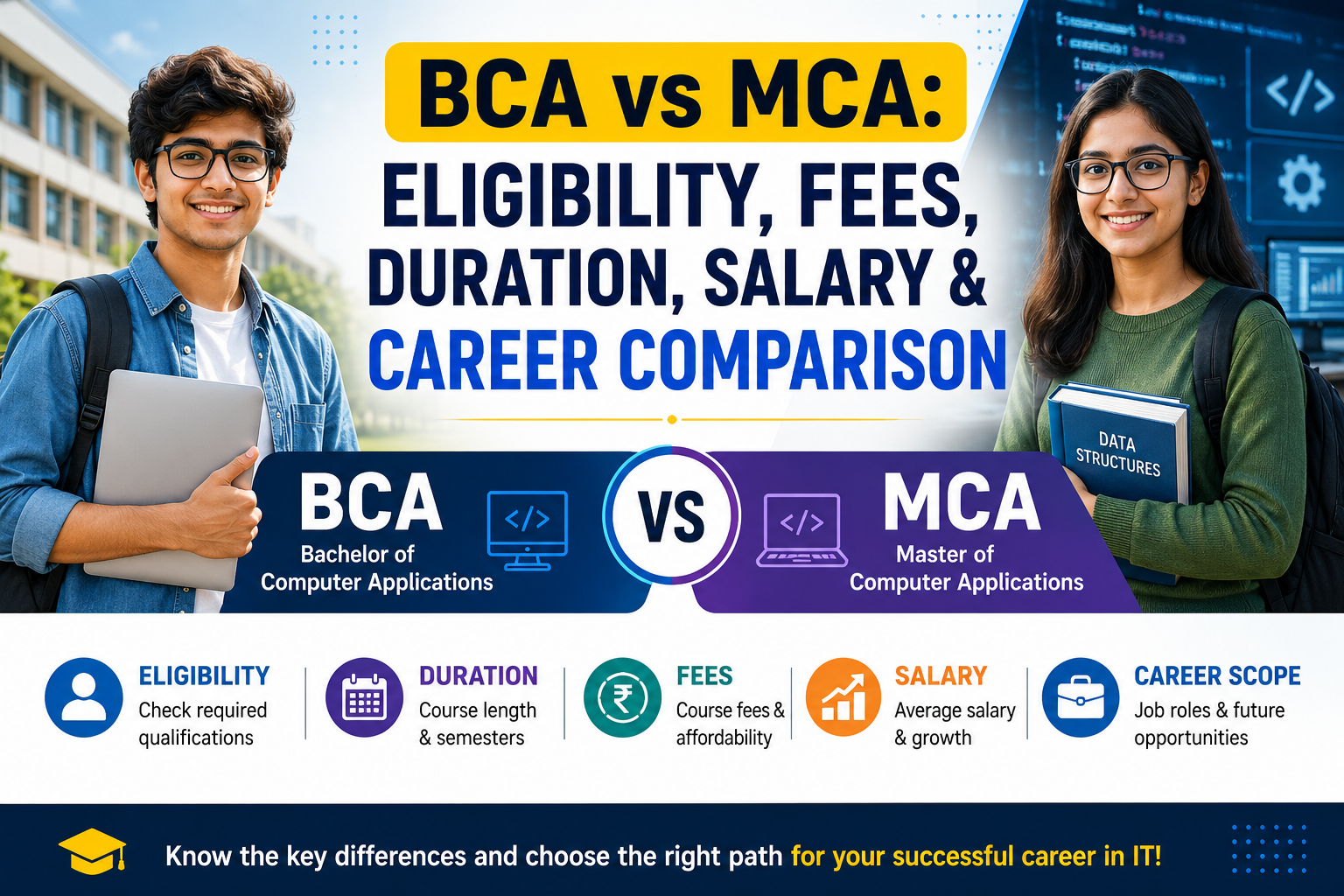
BCA vs MCA: Eligibility, Fees, Duration, Salary & Career Comparison

BCA and MCA aren’t rivals. They’re a sequence.

BCA is the three-year undergraduate degree you take after Class 12. MCA is a two-year postgraduate degree that you take after it. Asking which is better is a bit like asking whether Class 10 beats Class 12. The real question is whether you stop after the BCA course and start earning, or spend two more years and enter at a different level.

Money makes the case plain. BCA freshers start around ₹3–8 LPA. MCA graduates average ₹7–10 LPA, with experienced professionals crossing ₹20 LPA. Below: eligibility, duration, fees, salary and career paths for each, separately.

Key takeaways 

  • BCA: 3 years after 10+2, any stream, 45–50%. Four years under the NEP honours route.
  • MCA: 2 years after graduation. UGC cut it from three years to two in 2020; most blogs still get this wrong.
  • Fees overlap more than people assume: BCA ₹10,000–3 lakh a year, MCA ₹20,000–2 lakh.
  • Jobs after BCA : developer, web developer, data analyst. MCA is what unlocks architecture and senior engineering roles.
  • You don’t need a BCA to do an MCA. BSc and B.Tech graduates qualify; Class 12 Maths is the usual hard requirement.

BCA vs MCA at a glance 


BCA

MCA

Level

Undergraduate

Postgraduate

Duration

3 years (4 under NEP honours)

2 years

Eligibility

10+2, any stream, 45–50%

Graduation with Maths, ~50%

Entrance

Merit or university test

CUET PG, NIMCET, TANCET, university test

Annual fees

₹10,000–3,00,000

₹20,000–2,00,000

Fresher salary

₹3–8 LPA

₹4–12 LPA (avg 7–10)

Entry roles

Web developer, junior developer, data analyst

Software engineer, system analyst, cloud engineer

Eligibility: who can apply 

For BCA, you need 10+2 from a recognised board with 45–50% aggregate. Any stream, Science, Commerce or Arts. Most good universities prefer Mathematics or Computer Science as a Class 12 subject, and some insist on it. A few run a foundation module for students who arrive without it.

For MCA, you need a bachelor’s degree with roughly 50%. BCA is the natural feeder, but BSc (IT/Computer Science), B.Tech and other graduates qualify at most universities. The condition that catches people is Mathematics, usually required at the Class 12 or graduation level. Candidates from non-computing backgrounds may need a bridge module in semester one.

Admission routes differ, too. BCA is mostly merit-based or via a university test. MCA runs through CUET PG, NIMCET, TANCET or an institutional exam, depending on where you apply.

Duration: three years, then two 

BCA runs for three years across six semesters. Under NEP 2020, many universities now offer a four-year honours-with-research version with multiple exit points, a certificate at one year, diploma at two, degree at three. That structure also creates a smoother bridge into postgraduate study abroad, which the three-year version never had.

MCA is two years, four semesters. This is the detail most sources still get wrong: UGC reduced it from three years to two back in 2020. If an article tells you three, it’s outdated, and the error distorts the entire cost calculation.

Total run for both: five years. Same as an integrated law degree, one year more than B.Tech.

Fees: what each actually costs 

College type

BCA (per year)

MCA (per year)

Government / aided

₹10,000–40,000

₹20,000–50,000

Private university

₹80,000–3,00,000

₹60,000–2,00,000

Typical mid-range

₹60,000–1,20,000

₹50,000–1,00,000

Two things worth noticing. First, MCA is often cheaper per year than BCA at private universities, which surprises people, postgraduate programmes carry lower headcounts and less marketing overhead. Second, the honest number is the five-year total, not the annual fee. Model BCA plus MCA as one investment, because that’s how you’ll actually pay it.

Entrance-linked scholarships change the real figure at private universities, sometimes substantially. Compare after waivers, not on sticker price.

Salary: what the gap really looks like 

BCA freshers land ₹3–8 LPA. The spread is wide because it tracks skills, not the degree, a graduate with a project portfolio and cloud certifications sits at the top of that band, one with neither sits at the bottom.

MCA graduates average ₹7–10 LPA, with freshers at ₹4–8 LPA and experienced professionals crossing ₹20 LPA. The premium comes from role access rather than the certificate itself: MCA opens engineering and architecture positions that BCA-only candidates rarely get shortlisted for.

The caveat matters. These are national averages across cities, roles and company types. A Kolkata support role and a Bengaluru product role live at opposite ends of the same number, and skills move you further within a band than the degree moves you between bands.

Career paths: after BCA and after MCA 

After BCA: software developer, web developer, data analyst, system administrator, QA engineer. With a specialisation, cyber security, data analytics, and gaming, those tracks narrow and pay better. It’s a genuine three-year route into IT employment, which is the whole point of the degree.

After MCA: software engineer, system analyst, cloud engineer, data scientist, IT consultant. MCA is broadly treated as B.Tech-equivalent for hiring and for government job eligibility, which is precisely why BCA graduates return for it. Product companies hiring architects, government IT posts specifying a PG qualification, and teaching positions all filter on it.

The ceiling is the honest reason people go back. Two or three years into a junior role, promotions start going to postgraduates and engineering backgrounds, and the limit stops being theoretical.

Where students get this wrong 

  • Treating it as either/or. Most MCA students did a BCA first. The real decision is when, straight through, or after work experience.
  • Assuming MCA is still three years. UGC changed it in 2020, and the outdated number wrecks the cost-benefit maths.
  • Ignoring the Maths requirement. A BCA student who dodged maths modules can hit a wall at MCA admission.
  • Chasing the cheapest BCA colleges without checking placements. A ₹40,000 degree leading nowhere costs more than a ₹1.2-lakh one that places you.
  • Doing an MCA to postpone job-hunting. Recruiters can tell the difference between a strategic PG and a hiding place.

How to decide, step by step 

  1. Name your target role honestly. Web developer or junior analyst? BCA suffices. Architect, data scientist, government IT officer? You’ll need the MCA eventually.
  2. Check your Class 12 Maths status now. It determines whether MCA stays open.
  3. Model total cost across five years, not annual fees.
  4. Look at placement data by degree, not by college. The gap between a university’s BCA and MCA outcomes tells you what the PG is worth there.
  5. If you’re mid-BCA, decide in semester five, that’s when CUET PG or NIMCET prep needs to begin.
  6. Consider working first. Two years of industry experience make MCA coursework stand out, and some employers part-fund it.

Before you decide 

  • Skills beat a degree tier at the entry level. A BCA graduate with a portfolio out-hires an MCA graduate without one. The degree opens the interview; it doesn’t win it.
  • If you’re doing a BCA now, treat the specialisation seriously. Data analytics, cybersecurity and gaming tracks are what recruiters filter on.
  • Verify UGC-DEB approval for any online option at either level. An unapproved degree fails government eligibility checks at the worst moment.
  • Lateral entry into MCA’s second year exists at several universities, which shortens the detour for eligible candidates.

Studying computer applications at Adamas University, Kolkata 

For students comparing BCA colleges in Kolkata and West Bengal, Adamas University runs both ends of this pathway on one Barasat campus, which matters practically, since continuing from BCA into MCA at the same university removes an admission cycle from your plans. The BCA follows the NEP four-year structure with multiple exit points and tracks, including Gaming & Animation and BFSI; the MCA runs the standard two-year format. Admission works on standard eligibility through multiple routes, and scholarships for 2026-27 are tied to entrance performance rather than board marks alone.

Conclusion 

Stop framing this as BCA versus MCA. Frame it as: do I enter the industry at 21 and possibly return at 25, or plan the five-year run now? Both answers are defensible. The one that isn’t is drifting into an MCA because the job hunt got hard, or skipping it while quietly wanting the roles it gates.

If you’re weighing up BCA or MCA admission in Kolkata for the 2026 session, apply to Adamas University or call 1800-419-7423 to talk through which entry point fits your target role before this intake closes.

FAQs 

Can I do MCA without a BCA? 

Yes. BSc (IT/Computer Science), B.Tech and other graduates qualify at most universities, usually with Mathematics at Class 12 or graduation level. Candidates from non-computing backgrounds may need a bridge module in the first semester.

Is MCA still a 3-year course? 

No. UGC reduced MCA from three years to two in 2020. It now runs four semesters. Any source saying three years is out of date, and that error meaningfully distorts the cost comparison.

Which pays more, BCA or MCA? 

MCA, on average, roughly ₹7–10 LPA against ₹3–8 LPA for BCA freshers. But averages hide a wide spread. Role, city, company type and your actual skills move the number far more than the degree label.

What are the best jobs after BCA? 

Software developer, web developer, data analyst, system administrator and QA engineer are the common entry points. With a specialisation and a portfolio, cyber security and cloud roles open up. Senior architecture roles usually wait for an MCA or equivalent experience.

Should I do MCA immediately after BCA or work first? 

Both work. Going straight through finishes your education by 23. Working first makes the coursework more meaningful and sometimes gets partly funded. The wrong reason to go straight through is avoiding the job market.

Computer Science Eligibility: Qualification, Age Limit & Requirements

Computer science eligibility in India comes down to three things: passing 10+2 with the right subjects (Mathematics is the non-negotiable one), meeting the minimum aggregate your target course demands, and clearing whichever entrance route the university uses. For B.Tech Computer Science, that usually means 10+2 with Physics and Maths, plus roughly 45–60% aggregate depending on the institute. For BSc Computer Science, it’s 10+2 with Maths and around 50%. And here’s the part that surprises most students: there is no age limit for JEE Main, and most private universities don’t set one either.

This guide breaks down the exact eligibility for computer science at every level, course by course, so you know precisely where you stand before you fill a single application form.

Key takeaways 

  • Mathematics in Class 12 is the single most important computer science qualification. Physics matters for B.Tech; for BSc and BCA, Maths alone often clears the bar.
  • Minimum aggregate ranges from 45% to 60% for most universities. The famous 75% rule applies only to NITs, IIITs and centrally funded institutes, not to private universities.
  • NTA sets no age limit for JEE Main. You can attempt it for three consecutive years after Class 12, twice each year.
  • Entrance routes vary: JEE Main, state exams like WBJEE, or a university’s own admission test. Many good universities accept more than one.
  • A gap year, a PCB background, or marks below 75% does not end your computer science plans. Each has a workable route, covered below.

What is the eligibility for computer science courses in India? 

The baseline eligibility for computer science is a 10+2 pass from a recognised board with Mathematics as a subject, plus the minimum aggregate set by your target university, plus a qualifying entrance exam, where one applies. B.Tech programmes add Physics as a mandatory subject. BSc and BCA programmes are more flexible on the science side but still lean on Maths. That’s the whole framework; everything else is course-specific detail.

Now the detail, because the requirements shift meaningfully between the three main undergraduate routes.

  • B.Tech Computer Science Eligibility 

B.Tech computer science eligibility follows the pattern set by NTA and AICTE. You need 10+2 with Physics and Mathematics as compulsory subjects, along with one of Chemistry, Biology, Biotechnology or a technical vocational subject. Careers360’s breakdown of NTA rules confirms this subject combination applies to B.Tech admission through JEE Main.

Aggregate requirements depend on where you apply. NITs, IIITs and other centrally funded institutes demand 75% in Class 12 (65% for SC/ST) or a top-20-percentile board rank. Private and state universities typically ask for 45–60%. Adamas University in Kolkata, for instance, admits B.Tech CSE students through JEE Main, WBJEE or its own entrance process, which keeps the door open for strong candidates whose board marks fell short of the 75% cutoff.

  • BSc Computer Science eligibility 

BSc computer science eligibility is lighter than B.Tech. Most universities ask for 10+2 in the science stream with Mathematics, and a minimum aggregate near 50%. Some accept commerce students who took Maths. Physics and Chemistry help but are rarely mandatory.

Admission is often merit-based on board marks, though several universities run a short entrance or interview round. The three-year structure (four under NEP with an honours research year) makes it a solid pick for students who want computing depth without the engineering coursework.

  • BCA eligibility

BCA is the most open route. Standard eligibility is 10+2 in any stream with roughly 45–50% aggregate, and many universities want Mathematics or Computer Science as one of your Class 12 subjects. Under NEP, BCA programmes now run four years with multiple exit options, which several universities, Adamas included, have already adopted in their BCA NEP structure.

Age limit for computer science courses

There is no upper age limit for computer science admission at most Indian universities, and NTA imposes none for JEE Main. Shiksha’s analysis of the NTA criteria puts it plainly: candidates who passed Class 12 in the two preceding years, or are appearing in the current year, can sit for JEE Main regardless of age.

The real constraint is the passing-year window, not your birthday:

  • JEE Main: attempts allowed for three consecutive years from the year you clear Class 12, with two sessions per year — six attempts in total.
  • State exams and university tests: each sets its own window, usually similar to JEE Main’s.
  • Direct merit admission (BSc/BCA): most private universities accept a gap of a year or two without fuss, though it’s worth confirming with the specific admissions office.
  • After the JEE window closes, direct university admission routes remain open at many institutions, so an older marksheet is a detour, not a dead end.

B.Tech vs BSc vs BCA: eligibility compared 

Criteria B.Tech CSE BSc Computer Science BCA
Class 12 stream Science (PCM base) Science, some allow commerce with Maths Any stream
Mandatory subjects Physics + Maths Mathematics Maths/CS preferred, varies
Minimum aggregate 45–60% (75% for NITs/IIITs) ~50% 45–50%
Entrance exam JEE Main / WBJEE / university test Mostly merit, some university tests Mostly merit or university test
Duration 4 years 3–4 years (NEP) 3–4 years (NEP)
Best suited for Engineering roles, product companies, core development Research, MSc/MCA path, analytics Application development, IT services, MCA path

Benefits of meeting computer science eligibility early 

Sorting your eligibility in Class 11 rather than after results pays off in ways students rarely anticipate:

  • You pick the right third subject before it’s too late to change streams or add Maths.
  • You prepare for the right exam. Prep for JEE Main, WBJEE and a university test are three different games, and knowing your route early decides your study plan.
  • You avoid the results-day scramble where students discover a Maths requirement they can’t meet.
  • You build a realistic college list instead of a wishlist. Competition demands it: JEE Main’s January 2026 session drew a record 14.5 lakh registrations according to Careers360, up from 13.11 lakh the previous year.
  • You know where the crowd is heading. News18 reports that computer science remains the most sought-after branch among B.Tech aspirants, which keeps CSE cutoffs the highest across institutes.

Common challenges (and where students go wrong)

  • The 75% myth. The single most expensive mistake is assuming the 75% rule applies everywhere. It doesn’t; that criterion governs admission to NITs, IIITs and centrally funded institutes only. Students with 68% in boards have dropped a full year to “improve” marks they never needed, when private universities would have admitted them on their JEE score or an institutional test that same season.
  • The PCB trap. Biology as your third subject is fine for JEE Main’s B.Tech paper, but Mathematics is still mandatory. PCB without Maths closes B.Tech CSE, though BCA at universities that don’t insist on Class 12 Maths remains open, and a few offer bridge modules to cover the gap.
  • Board-specific subject names. Students from vocational or open-school backgrounds sometimes hold subjects that boards label differently from what admission forms expect. NIOS students, for example, qualify if they’ve passed five subjects including the mandatory ones. When in doubt, email the admissions office with your marksheet before applying, not after rejection.

Step-by-step guide to checking your computer science eligibility

  1. List your Class 12 subjects and stream. Confirm you have Mathematics; for B.Tech, confirm Physics too.
  2. Calculate your aggregate the way universities do. Best-of-five or all-subjects rules differ by board and institution, and the difference can be 3–4 percentage points.
  3. Match your profile against the course type. PCM with 60%+ opens every route. Maths without Physics points to BSc CS or BCA. No Maths narrows you to select BCA programmes.
  4. Pick your entrance route. JEE Main for national reach, WBJEE if you’re targeting West Bengal, or direct university admission tests. Check which exams your shortlisted universities accept; many, including Adamas, accept all three.
  5. Verify the passing-year window. JEE Main covers the current year plus the two before it. Older marksheets need direct-admission routes.
  6. Confirm category-specific relaxations. SC/ST candidates get a 65% threshold at centrally funded institutes, and many universities extend aggregate relaxations for reserved categories.
  7. Apply before the deadline, then keep documents ready. Marksheet, board certificate, entrance scorecard, category certificate where applicable, and a valid ID.

Expert tips backed by data 

  • Treat the exam and the eligibility criteria as two separate checklists. Careers360’s reading of the NTA rules makes the distinction explicit: no minimum percentage is needed to appear for JEE Main, since the marks criteria bite only at counselling for centrally funded seats. Write the exam even if your boards went badly; a strong score keeps private-university doors wide open.
  • Watch the demand data when you build your list. News18’s analysis of JEE Main 2026 notes that of the roughly 12–13 lakh students who take the exam each year, only about 40,000 land seats in IITs, NITs, IIITs and other centrally funded colleges. The rest aren’t out of options; they’re choosing between state universities and private institutions, where eligibility bars sit at 45–60%, and multiple exams are accepted.
  • Check scholarship criteria alongside eligibility. Several private universities tie scholarships to entrance performance rather than board marks alone; Adamas publishes its scholarship policy for 2026-27 openly, and comparing such policies can change your actual fee outlay more than the tuition figure does.
  • Verify against the current year’s official bulletin. NTA revised its passing-year rules more than once in the past five years, and universities update NEP-related course structures annually.

Studying computer science at Adamas University, Kolkata

If you meet the eligibility criteria above and are looking at computer science courses in Kolkata or anywhere in West Bengal, Adamas University’s Barasat campus runs one of the widest CSE portfolios among private universities in the state. The Department of Computer Science and Engineering covers the full undergraduate spectrum:

  • B.Tech Computer Science Engineering plus specialisations in AI & Machine Learning, Cyber Security and Forensics, Data Analytics, and Cloud Computing.
  • BCA under NEP, including Gaming & Animation and BFSI tracks, with the four-year multiple-exit structure.
  • MCA and M.Tech CSE for students planning beyond the bachelor’s.

Admission works through JEE Main, WBJEE or the university’s own entrance process, so the eligibility bars discussed in this guide (rather than the 75% CFTI rule) are what apply. Scholarships under the 2026-27 policy are linked to entrance performance, and the 120-acre campus sits on the Barasat–Barrackpore Road in North 24 Parganas, within commuting distance of Kolkata.

Conclusion

Computer science eligibility is more forgiving than the cutoff headlines suggest. Mathematics in Class 12 is the real gatekeeper; aggregate requirements at most universities sit at 45–60%, not 75, and age is rarely the barrier students fear it is. Check your subjects, confirm your aggregate against the specific university’s rules, and pick the entrance route that matches your profile.

If you’re eligible and targeting a B.Tech CSE or BCA seat in West Bengal for the 2026 session, start your application to Adamas University or speak to an admissions counsellor on 1800-419-7423 before this year’s deadlines close. A ten-minute call settles eligibility doubts faster than a week of forum threads.

Significance of Computer Science Engineering in a COVID-19 infested Era

Ever since the outbreak of COVID-19 or the novel coronavirus from December 2019 till date, the whole world is adversely impacted by the induced pandemic which has forced on every form of the established system, a drastic change in the day-to-day lives of the people belonging to different strata of the society. The socio-economic setup that was prevalent throughout the world, is already significantly shattered, and hence calls for the conceiving as well as establishing a new system wherein the various functionalities may ensure the smooth and orderly execution of different aspects of the human society can be reinstated keeping in mind the robustness of this system against a pandemic like situation such as these.

This COVID-19 infested pandemic has exposed major loopholes and faulty perceptions regarding the various domains like, healthcare sector, financial institutions & bodies, educational establishments, research & developments bodies as well as public welfare organizations, as a result of which the whole world community stands not just clueless but also helpless in grappling with the current catastrophe.

a) Impact of Covid on the domain

The viral outbreak at a massive global scale has forced governments across the world to impose hard lockdowns and travel restrictions thereby compelling the shutdown of offices that offer varied services related to several sectors. Furthermore, at an individual level, people need to maintain a safe distance and be physically covered (especially facial areas) at maximum times when outside. This has invariably impacted interpersonal communication greatly.

Considering all the above factors, a computer/smartphone device, internet connectivity and a relatively stable power supply has come to the rescue of people in many ways. Professionals associated with the computer science & engineering domain are able to maintain various sorts of data in large bulks securely and meticulously with the help of different technologies. Furthermore, with the advent and development of the internet infrastructure, an abundance of virtual space can be created and managed for warehousing these data. Various applications are these days widely used via handheld devices to serve day-to-day purposes like product or food delivery, cab or train booking, hotel booking, seat reservation at any event, online academic courses, online mails, messaging and meeting and so on.

With this current pandemic prevailing all over, the usage of the above online applications is greatly amplified as these software-based utility tools are proving to be beneficial in running the various sectors simply while sitting at home. More and more people are continually seeking online services and demanding applications that will make it possible in every way to handle various business or commercial activities, smoothen the functioning of the education and healthcare sector and providing real-time support to travel as well as transport services. Even in the entertainment industry and also crime investigation & forensics, complex application development with easy user-friendly outlooks are ever-growing.

In short, the computer science & information technology domain has invariably become even more lucrative, prospective and ever-growing field as the pandemic has forced majority of the services to go “online”. Interestingly, a number of professions has by this time become obsolete and many individuals lost their jobs except for some cases such as this domain. These days the most important and valued element is data on various things and this data is available in such large quantities that it needs organized storage and management. While attempting to find a robust and effective solution to the COVID-19 virus, several amounts of data are being recorded and used. Efficient handling and accessing of such data is thus necessitated which is realized by the applications developed by various professionals who are experts in the computer science field.

b) New trends

As mentioned earlier, several sectors across the world are either closed down or grappling to survive by somehow managing to lift their face up the troubled waters of the pandemic crisis. An interesting trend of relying on online services is being noticed among such sectors.

Education: With almost all academic institutions physically shut down, this sector has shifted to online mode of admission, lecture delivery, examination conduction, assignment delivery, subject-wise note sharing and student evaluation. These activities require the support of some multimedia-enabled devices having a camera, microphone and speaker, online document preparing web services, and virtual (cloud-based) storage space. There has emerged a vogue of online coaching and academic preparation via the use of mobile apps like Byju’s Classes, Unacademy and so on which have reduced the dependency on availing tutors. Altogether, all these necessitate the development of software-based applications that require the expertise of domain professionals.

Healthcare: Currently as the majority of the professionals in this sector are the frontline ‘warriors’ in this battle against the pandemic, naturally, they are highly exposed and vulnerable to the COVID-19 virus attack. Despite the extreme precautions taken, most of them even are losing their lives to this deadly virus given the highly contagious environment they are working in. This has led to a fear of psychosis among the general public to avoid visiting the doctors and other medical professionals for a routine health checkup.  As a result, the growing demand for online health checkup from home has led many software and app developers to build such dedicated applications that aid in routine healthcare and delivery of medicines. Some of the prominent apps operating in India are DoctorOnDemand and PharmEasy.

Business, Commerce, Banking & Industry: Several commercial and industrial workplaces are physically shut thereby causing losses and job cuts. A growing need has propped up for automation of industrial machinery and online support to various financial services as well as transactions, remote ordering, selling and purchasing, delivery of items. Some of these applications are realized by popular app services like Yono app (State bank of India), PolicyBazaar, Amazon, Flipkart, Paytm, Myntra.

c) Areas of research

Unlike other domains where research and development include extensive needs for laboratory or enterprise-level facilities and field works, pursuing research in the computer science domain requires just three things at home: a good quality computer system/workstation, internet connection and access to research-level online repositories. There are several open-source development tools that can be downloaded and utilized for effective research. Some of the major domains where computer science has pervaded are Medical science, genetics & genomics, microbiology, transport technologies, core industrial & engineering, basic sciences. Researchers under this domain by sheer knowledge of Artificial Intelligence, Data Science, Machine Learning and Deep Learning are gradually succeeding in presenting automated models for determining the nature and spread of the COVID-19 virus. Although the concept of Artificial Intelligence is not new (coined in 1956 by John McCarthy), the extensive development and the need for massive automation across several fields has uplifted the status of this concept that has led to enhanced research in Artificial Intelligence, Data Science, Machine Learning and Deep Learning. In short, a professional equipped with such domain knowledge easily feels valued and almost indispensable across several multi-disciplinary fields.

Unravel the mystery of M.Tech in Computer Science

Are you a final-year student? Are you in dilemma about what should be your next step for your career? Is it a job you need after your B.Tech or is it a certification you need to kickstart your career or you need an M.Tech to give a boost to your career? These are quite common questions that dwell in every engineering students mind.

In my old days, I was also had the same state of mind and it got more fuel when I saw that some of my friends started preparing for GRE, TOFEL and some took some MNC based jobs and some joined some started preparing for some government jobs.    

First, let me share my side of the story for going ahead with M.Tech. I saw a few of my seniors work under different IT companies and found there they not only need to be shinning every day but they have to upskill themselves mostly on a regular basis. As most of the curriculum does not cater to the present-day industry needs. Most importantly it is very challenging to upskill and perform in your job on a daily basis.

Though the short-term certifications will earn you various skills unfortunately it will never be enough for you to increase your scale to a different level. Whereas post M.Tech the job perspective and eligibility for your career multiplies exponentially. Not only you are eligible for industry jobs but you can be a part of building an engineering society by producing quality engineers and also can contribute to different research activities and see your creation come live and help society. 

Some students have experienced the importance of having a post-graduation degree, post they had spent around more than 5 years in the industry and had set for the different executive program but most cases these executive programs are not a full-time program and not focused in developing a strong academic background. 

Is GATE is mandatory for perusing M.Tech in Computer Science and Engineering?

GATE is just a competitive examination by which students can be evaluated with a common test thus giving the selectors a common criterion to select candidates. But if you are academically strong then you can peruse M.Tech without GATE.

What awaits for me post M.Tech in Computer Science and Engineering?

The opportunities get increased exponentially post M.Tech. Your option of joining the industry becomes wider with a higher package, along with you can be a part of any academic institute, research institute, government institute, private institute, peruse PhD to name a few.

Which branch should I choose for my M.Tech course of studies?

You can choose any branch of studies for your M.Tech course but as per the regulation of various government bodies and looking at your career it is advisable the course should be relevant to your B.Tech course of studies. 

Where to study M.Tech?

At Adamas University, we design and update our curriculum frequently to meet the changing demand of the present-day industry while making you academically aware of many of your future endeavours.  

Why Computer Science?

“The Computer was born to solve the problem that did not exist before” – Bill Gates.

As a machine reduces the work effort, so does a computer for a typical complex computation. Computer science forces you to deal with a problem in a slightly different way which is a skill that can be applied to life itself. In the era of data, a computer is the most indispensable thing we can think of. Computer science gives you an opportunity in working and understanding hands-on the aspect of data.

Computer Science is the study of principles and the use of computers. The classical areas for a computer science course include discrete mathematics, data structure, theory of computation, compiler design, analysis and designing of Algorithm. The advanced study includes artificial intelligence (AI), computer networks and security, database management systems, computer vision and graphics, numerical analysis, software engineering, bioinformatics.

Apart from this, a computer engineer is supposed to be known as a fluent coder. Coding is the ‘Bread and Butter’ for all computer engineers. Programming or coding is an intriguing sector as it gives us the superpower to regulate computer programs on the go. The main goal for a computer engineer is to make a problem understandable to a machine so that it could solve the problem obligingly. The fluency and smoothness of an application are solely based on the way you design the code. C, the mother of all programming languages, is a general-purpose programming language that is extremely popular, simple, and flexible to use. It helps a programmer to build the base of designing a program.  It is a structured programming language that is machine-independent and extensively used to write various applications, Operating Systems like Windows, and many other complex programs like Oracle database, Git, Python interpreter, and more. Java, a high-level programming language, is also the most popular language for its design structure using object-oriented concepts (OOP). When it comes to the web, Java is unparallel. Most of the web-based applications are based on java. Apart from this, there are several programming languages like c++, python, Matlab, R to name a few.

There are innumerable and varied specialization and career options for a computer engineer. After completing his/her B.Tech degree a student may get absorbed in the software industry or may opt for higher studies. There are multiple sub-division and specializations in Computer Engineering which require applications in various sectors. Student can also pursue B.Tech degree in various applied fields:

  • AI/ML: Artificial Intelligence (AI) are emerging fields that will shape and dominate the future of this universe. Data is one of the most important assets of a company or government agency. It helps us to predict the future based on past experiences. AI has the potential to vastly change the way that humans interact, not only with the digital world but also with each other, through their work and other socioeconomic institutions – for better or for worse. A vast volume of data can be analysed by using a smart alternative, Machine Learning. It can produce an accurate result by designing a fast and efficient model for real-time data.
  • Blockchain: The duration of the course for B.Tech with specialization in blockchain is four years. Blockchain is currently booming and one of the most popular technologies that have invaded to almost every industry in the world. The world is changing its shape towards cryptocurrency. In near future, Bitcoin will be one of the popular transaction media. The main technology behind this is the blockchain. The technology will help the student to learn different algorithms and to curate the bitcoin on their own.
  • Cyber Security: Cybersecurity provides an expertise insight analysis on global security threats. In the world of web, to provide a secure web service is one of the main goals. The course on Cyber Security will help to learn different algorithms along with the expertization on ethical hacking, penetration testing, digital forensics. There are immense career avenues open for specialization in cybersecurity. This includes Security software developer, security analyst, security architect etc.
  • M.Tech Degree in Computer Science: Apart from doing graduation and going for an early job, a student may go for a master’s degree in computer science and engineering along with the specialized degree discussed above.

With the knowledge and concept in the domain, a computer science engineer can be eligible for an immense variety of job opportunities. Some of them are jotted below:

  1. Computer Science engineers are the primary resource of the software industry. With a sound concept in the subject, a student can crack any of the big houses easily.
  2. Government sectors such as I.S.R.O, B.H.E.L, etc are recruiting computer science engineers having a good GATE score.
  3. Interdisciplinary research is a new trend for Computer Science students. Inter-disciplinary subjects such as IoT, Bioinformatics provides a huge contribution in research for computer science students.
  4. Apart from interdisciplinary research, mainstream research in computer science also provides a huge scope for the student both nationally and internationally.

 As a computer science engineer, there are plenty of opportunities in Government sectors as well as private sectors. A focused, sincere and conceptual student has all the possibilities to touch the sky.

Skip to content