

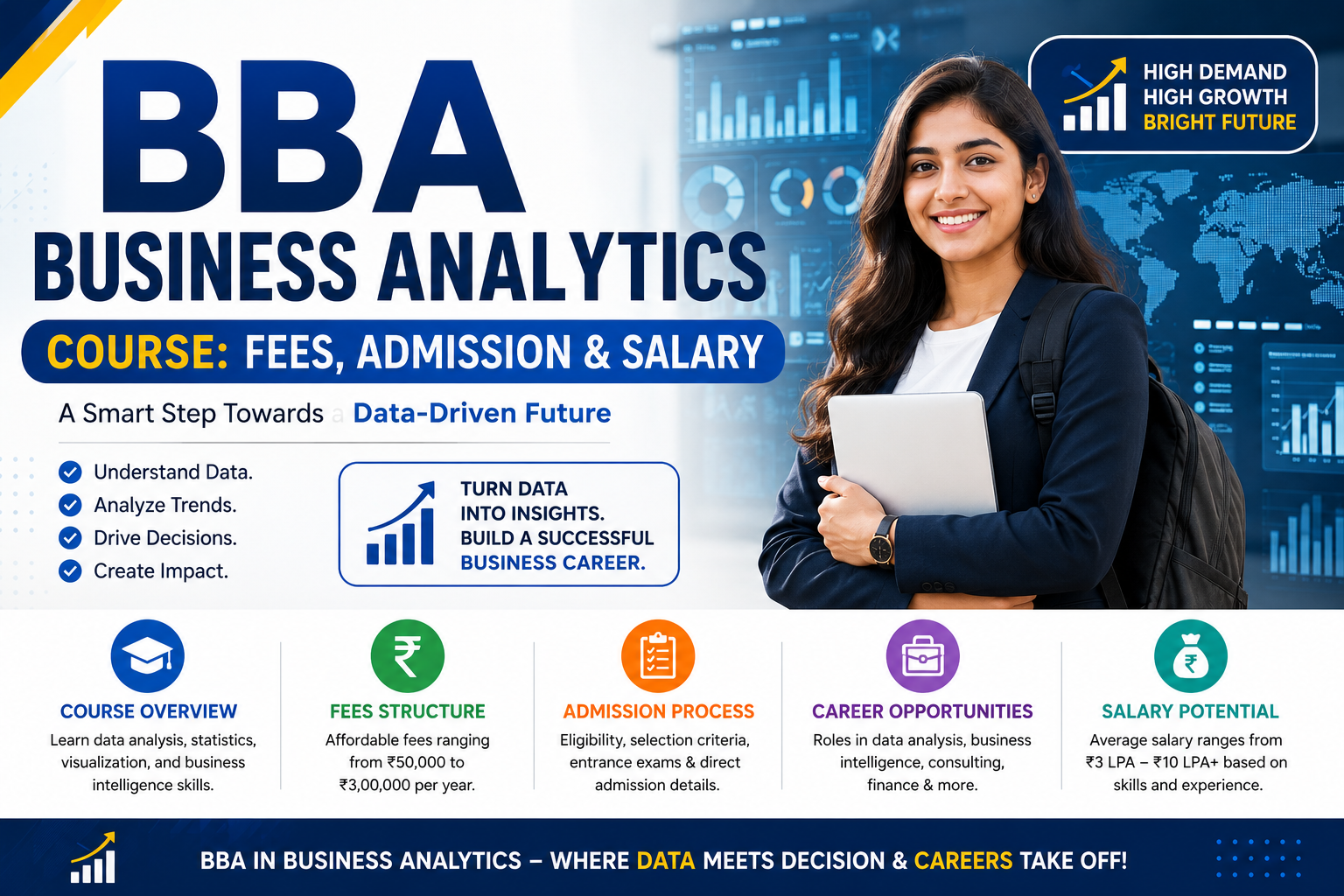
A BBA business analytics course is a three-year undergraduate degree that teaches you to read business problems through data, statistics, visualisation, predictive modelling and BI tools, wrapped around a standard management curriculum. Admission needs 10+2 from any stream, usually 50% aggregate. Fees run from ₹1–5 lakh for the full programme. Freshers earn ₹4–7 LPA, rising to ₹6–12 LPA for analytics and consulting roles.
Why it’s worth looking at: the ManpowerGroup 2026 Talent Shortage Survey puts analytics and IT skills among the top three skill clusters that Indian employers can’t fill. This degree points straight at that gap. Fees, admission and salary are broken out separately below.
Key takeaways
- Three years, six semesters, open to Science, Commerce and Arts students. No engineering background needed.
- The syllabus is genuinely different from a general BBA, Business Statistics, Data Visualisation, Predictive Analytics, and Business Intelligence.
- BBA Business Analytics in India feeds a real hiring corridor: IT and consulting, BFSI, e-commerce, retail, healthcare analytics, telecom.
- Tools matter as much as marks. Excel, SQL, Power BI, Tableau, Python or R, recruiters filter on these.
- Most graduates start as Business Analysts or Data Analysts. MBA or a specialised PG is the usual next step.
What you actually study
Half business, half data, and the interesting bit is where they meet.
The management core stays: financial management, marketing, organisational behaviour, economics. Then the analytics layer goes on top, Business Statistics early, then Data Visualisation, Predictive Analytics, Business Forecasting, and usually a Machine Learning or Big Data introduction later. Marketing Analytics and Financial Analytics apply the toolkit to specific functions.
The point isn’t to make you a data scientist. It’s to make you the person who can look at a dashboard, spot what it’s actually saying, and turn that into a business decision. That translation job is the degree, and it’s why the management subjects stay rather than getting dropped for more maths.
Hands-on work runs throughout, including Excel and R, dashboards, case studies, and a capstone. A programme with no project portfolio at the end isn’t teaching this properly.
BBA vs BBA Business Analytics vs BCA
|
General BBA |
BBA Business Analytics |
BCA |
|
|
Focus |
Broad management |
Management + data decision-making |
Programming and software |
|
Eligibility |
10+2 any stream |
10+2 any stream, ~50% |
10+2, Maths/CS preferred |
|
Core skills |
Marketing, finance, HR |
Statistics, visualisation, BI tools |
Coding, databases, systems |
|
Entry roles |
Sales, marketing exec |
Business analyst, data analyst, MIS analyst |
Developer, system admin |
|
Entry salary |
₹3–6 LPA |
₹4–7 LPA (₹6–12 at top end) |
₹3–8 LPA |
|
Next step |
MBA |
MBA (Analytics) or PG in data science |
MCA |
Fees: what the course costs
|
College type |
Total programme fee |
Per year |
|
Government/state university |
₹30,000–1,00,000 |
₹10,000–35,000 |
|
Mid-range private university |
₹1,20,000–2,50,000 |
₹40,000–85,000 |
|
Top-tier private |
₹2,50,000–5,00,000 |
₹85,000–1,70,000 |
The spread is the problem. The same course name costs ₹1 lakh at one university, and ₹5 lakh at another, and the difference is supposed to be labs, faculty and placements. Verify that it actually is before paying the premium.
Two practical notes. Entrance-linked scholarships at private universities change the real number substantially, so compare after waivers rather than on sticker price. And factor in what you’ll spend outside the fee: certifications, a decent laptop, and occasionally paid tool licences. Budget a little beyond tuition.
Admission: the process, step by step
Eligibility is 10+2 from any recognised board, generally 50%+ aggregate. Some universities set subject-wise minimums as well, so read the fine print before assuming you qualify. Maths in Class 12 helps with the statistics papers, but it isn’t mandatory at most institutions.
Admission route varies: most private universities admit on Class 12 merit or their own entrance test; some accept CUET. A few ask for a statement of purpose or a short interview.
The sequence:
- Confirm eligibility against the specific university’s criteria, including any subject-wise minimum.
- Shortlist on the semester-wise course grid, not the brochure. Check for named tools and a capstone project.
- Register on the university portal and fill out the application.
- Keep documents scanned and ready: 10th and 12th marksheets, photo, signature, ID, category certificate, where applicable.
- Sit the entrance test or interview where required.
- Compare offers after scholarships, then complete document verification and pay to lock the seat.
Deadlines cluster between May and July for the autumn session, and merit rounds close earlier than most applicants expect.
Salary: what graduates actually earn
|
Role |
Entry-level (₹ LPA) |
With 3–5 years |
|
Data Analyst |
4–6 |
8–12 |
|
Business Analyst |
4–7 |
9–14 |
|
MIS Analyst |
3.5–5 |
6–9 |
|
Analytics roles at consulting firms |
6–12 |
12–20+ |
The averages hide what actually moves the number. Tool proficiency and a project portfolio decide where inside a band you land; a graduate with three dashboard projects and SQL fluency starts meaningfully above one with a better CGPA and neither. City matters too: metro postings pay well above the national average for identical roles.
The reason the ceiling is high is structural. Analytics roles attach to revenue decisions, and work that visibly moves revenue gets paid for. That’s also why the field rewards specialisation by year three rather than staying a generalist.
Why students pick it over a general BBA
Specificity. A general BBA graduate and a BBA Business Analytics graduate apply for the same first job; only one of them can open a dataset and say something useful. In a market where the analytics shortage is documented rather than rumoured, that’s a measurable edge.
You also learn the tools while young. Excel, SQL and a BI platform are learnable at 19 with time to build projects, and they stay useful whether you end up in marketing, finance or operations. Even if you never take an analyst title, the literacy compounds.
What’s difficult about it
- The maths is real. Not engineering-level, but Business Statistics arrives in year one and doesn’t leave. If numbers genuinely frighten you, a general BBA will be a happier three years.
- Programme quality varies wildly. Some universities relabelled a general BBA, added two analytics papers and raised the fee. If the course grid names no tools, be suspicious.
- The degree alone doesn’t hire you. Recruiters ask what you’ve built every time.
- It’s an undergraduate degree in a field that often wants postgraduate depth. Plan for an MBA or PG eventually, rather than being surprised by it.
What actually gets you hired
- Learn SQL early, on your own, in year one. It’s the most-requested skill in analyst job posts, and most curricula reach it late.
- Build in public. Three real projects, a sales dashboard, a churn analysis, and something off a public dataset do more for placement than any elective choice.
- Pick your internship for the data, not the brand name. A small company handing you their actual messy sales data teaches more than a big firm handing you slides to format.
- Don’t skip the management subjects to focus on tools. People who plateau in analytics are usually the ones who can query but can’t argue a recommendation to a room.
Studying business analytics at Adamas University, Kolkata
For students comparing BBA colleges in Kolkata and West Bengal, the School of Business & Economics at Adamas University runs its BBA in Business Analytics around case studies and workshop-based teaching rather than lecture-only delivery. Two points from their own published data: the BBA programme reports an 87.5% placement rate, with the remaining students moving to MBA study, and listed recruiters include Aditya Birla Finance, TATA AIG General Insurance and Experis IT. The university also runs an MBA in Business Analytics delivered with SAS as an industry partner, relevant if you’re already thinking about the postgraduate step this field usually calls for. Scholarships for 2026-27 are linked to entrance performance.
Conclusion
A BBA in Business Analytics is a good bet if you like business but want proof behind your arguments, and a bad one if you’re hoping the word “analytics” on a certificate does the work. The degree gives you the vocabulary and the tools. The projects, the internship and the SQL you taught yourself get you hired.
If you’re considering a BBA Business Analytics course in Kolkata for the 2026 session, apply to Adamas University or call 1800-419-7423 to ask about the semester structure and placement record before this intake closes.
FAQs
Can commerce or arts students do a BBA in Business Analytics?
Yes. The course accepts 10+2 from any stream. Maths in Class 12 helps with the statistics papers, but isn’t mandatory at most universities. Willingness to work with numbers for three years matters more.
What is the difference between BBA and BBA Business Analytics?
A general BBA gives broad management grounding. The analytics specialisation keeps that core and adds statistics, data visualisation, predictive analytics and BI tools, aimed at data-driven decision roles. Same duration, different exit profile.
What are the fees for BBA Business Analytics?
Roughly ₹30,000–1 lakh total at government and state universities, ₹1.2–2.5 lakh at mid-range private universities, and up to ₹5 lakh at top-tier private institutions. Entrance-linked scholarships can cut the private figure considerably.
What is the salary after a BBA in Business Analytics?
Entry-level roles typically pay ₹4–7 LPA, with analytics and consulting positions reaching ₹6–12 LPA. Three to five years in, Business Analysts commonly reach ₹9–14 LPA. Tool skills and a project portfolio move the number more than the degree does.
Do I need an MBA after a BBA in Business Analytics?
Not immediately, but most people get there. The undergraduate degree opens analyst roles; the MBA or a specialised PG typically opens the managerial layer above. Two or three years of work first usually makes the PG more valuable.
Visited 2207 times, 1 Visit today

