


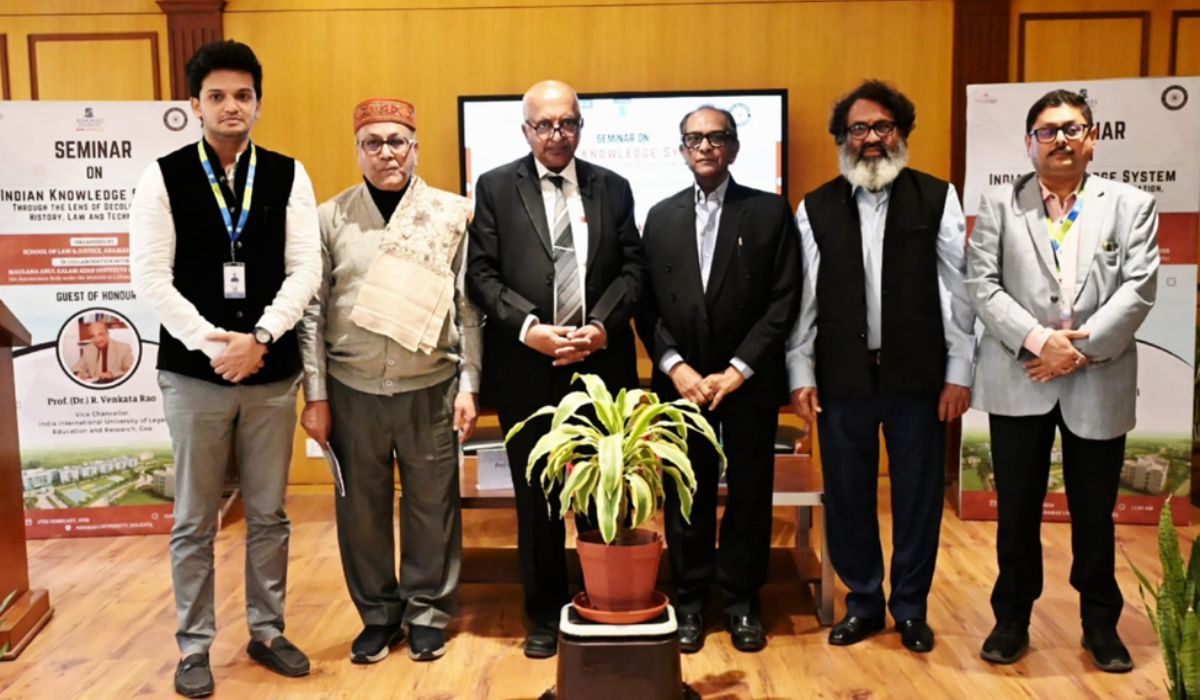
In a landmark gathering that reaffirmed the civilizational richness of India's indigenous intellectual heritage, the School of Law & Justice, Adamas University, in collaboration with the Maulana Abul Kalam Azad Institute of Asian Studies (MAKAIAS) — an autonomous body under the Ministry of Culture, Government of India — hosted a Seminar on the Indian Knowledge System (IKS): Through the Lens of Decolonization, History, Law and Technology on 17th February 2026, drawing together over a hundred scholars, legal practitioners, technologists, and policymakers under one roof at Kolkata. This seminar was a result of a grant of 2 Lakh 50 Thousands that was funded by MAKAIAS.
The day-long event, graced by Prof. Suranjan Das (Vice Chancellor, Adamas University), Prof. R. Venkata Rao (Vice Chancellor, IIULER, Goa), and Prof. Heeraman Tiwari (Jawaharlal Nehru University). It unfolded as a richly layered intellectual conclave that traversed the full spectrum of India's epistemic legacy — from the jurisprudential underpinnings of the Arthashastra and the ecological cosmology encoded in Puranic myth, to the pressing contemporary questions of bio-piracy, collective intellectual property, and ethical digitization of oral traditions — with the keynote address by Prof. Das powerfully anchoring the discourse in the mandate of NEP 2020 and its vision of an 'India-Centric Educational System' that decolonizes not merely syllabi but the very philosophical foundations of knowledge.
The seminar was particularly notable for its fearless interdisciplinary reach: legal scholars interrogated whether a jurisprudence born of colonial modernity could ever adequately protect knowledge systems built on entirely different ontological premises; historians recovered the subaltern and regional dimensions of IKS that dominant Sanskritic narratives had often obscured; and a biotechnologist from Adamas University electrified the audience by demonstrating how the 'web of stories, mysteries and myths' surrounding Jambudwip encoded sophisticated empirical understandings of ecology and medicine centuries before the Enlightenment gave the world its taxonomy of sciences. Perhaps the seminar's most arresting intellectual motif — one that cut across every session — was the implicit dialogue it opened between Shakespeare and the Mahabharata: where generations of colonial education had elevated the Bard as the supreme summit of dramatic and philosophical imagination while relegating Vyasa's encyclopaedical epic to the margins of religion and mythology, speaker after speaker drew pointed inferences about the epistemic violence of this asymmetry, arguing that the Mahabharata's treatment of dharma, statecraft, moral agency, and cosmic jurisprudence not only rivals but in significant ways surpasses anything in the Western literary canon — that Yudhishthira's dilemmas are as philosophically demanding as Hamlet's, that the Bhagavad Gita anticipates Kantian ethics and transcends them, and that to finally accord the Mahabharata its rightful place in the Indian university alongside Shakespeare is not an act of cultural chauvinism but of long-overdue epistemic justice. The seminar concluded with a call for the formation of an IKS Consortium — a permanent tri-sectoral platform uniting academia, law, and technology — and the resolve that India's universities must learn, at last, to know themselves.
