

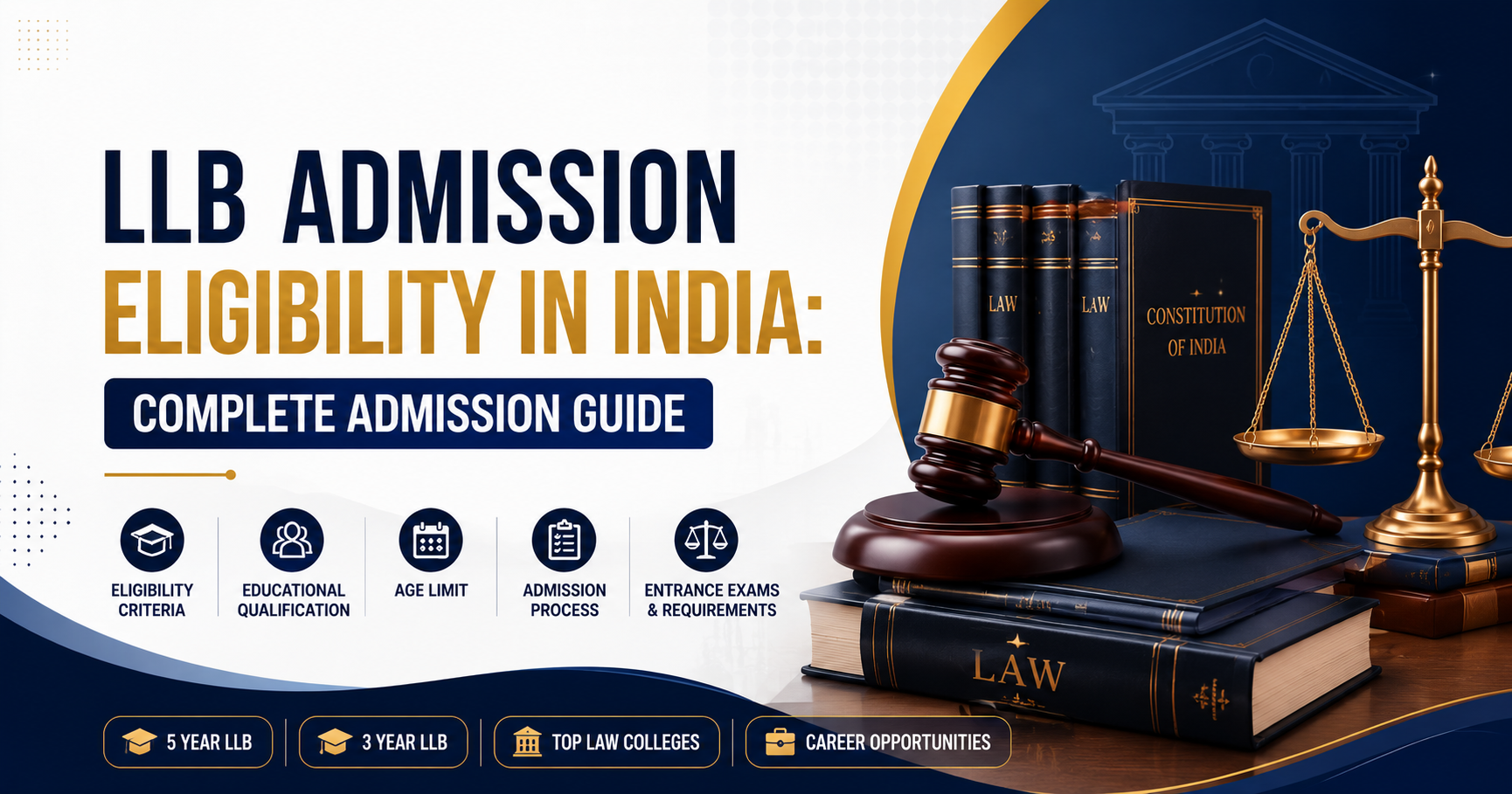
LLB eligibility in India follows two clear routes. For the 5-year integrated programme (B.A LLB, BBA LLB, B.Sc LLB), you need 10+2 from any stream with a minimum of 45% marks (40% for SC/ST). For the 3-year LLB, you need a bachelor’s degree in any discipline, again with roughly 45%. There is no upper age limit for either route; the Bar Council of India removed it entirely after the Supreme Court pushed back on the old caps. Beyond marks, admission runs through entrance exams like CLAT, LSAT India or a university’s own test, and the college must be BCI-approved for your degree to count.
That’s the short version. The rest of this guide covers the LLB admission criteria in detail, including the traps that cost aspirants a year.
Key takeaways
- Any stream works. Arts, science and commerce students are all eligible for B. A LLB in India and other integrated law programmes after Class 12.
- The marks bar is low: 45% in 10+2 for the 5-year route, 45% in graduation for the 3-year route, with relaxation for reserved categories.
- No age limit exists for either LLB format. BCI scrapped the 20/22-year cap for integrated courses and the 30/45-year cap for the 3-year LLB.
- CLAT is the biggest exam, but not the only door. LSAT India, state exams and university tests admit far more students than the NLUs do.
- Only a BCI-approved college makes you eligible to enrol with the State Bar Council and practise. Check approval before you pay a rupee.
What are the LLB eligibility criteria in India?
The LLB eligibility criteria depend on which of the two formats you choose, so start by locating yourself:
- 5-year integrated LLB (after Class 12): pass 10+2 from a recognised board, any stream, with 45% aggregate for General/OBC and 40% for SC/ST. You graduate with a combined degree, such as B. A LLB or BBA LLB rather than doing two separate courses.
- 3-year LLB (after graduation): hold a bachelor’s degree in any discipline from a recognised university, typically with 45% (40% for reserved categories). This is the standard route for career changers, and an engineer or commerce graduate qualifies exactly as an arts graduate does.
- Appearing students: if you’re awaiting Class 12 or final-year results, most universities let you apply conditionally and submit proof of passing at admission.
One rule sits above everything: the college must be approved by the Bar Council of India. BCI does not recognise LLB degrees earned through distance or correspondence mode, and a degree from a non-approved institution cannot get you enrolled to practise. Verify approval on the BCI list before applying, not after.
Is there an age limit for LLB?
No. There is currently no upper age limit for LLB admission in India, whether you pick the 5-year or the 3-year route. The history matters because outdated pages still confuse aspirants:
- BCI originally capped the 5-year integrated course at 20 years (22 for reserved categories) and the 3-year course at 30 years.
- After criticism from the Supreme Court, the caps were first raised, then removed entirely, as Shiksha’s admission guide confirms.
- A 35-year-old working professional can join a 3-year LLB today, and a 24-year-old can still take the integrated route if they prefer the combined degree.
The only practical age-related check: individual entrance exams and universities set application windows tied to your year of passing, so read the specific brochure.
5-year vs 3-year LLB: admission criteria compared
|
Criteria |
5-year integrated LLB |
3-year LLB |
|
Qualification needed |
10+2, any stream |
Bachelor’s degree, any discipline |
|
Minimum marks |
45% (40% SC/ST) |
45% (40% SC/ST) |
|
Age limit |
None |
None |
|
Degree awarded |
B.A LLB / BBA LLB / B.Sc LLB |
LLB |
|
Main entrance exams |
CLAT UG, LSAT India, SLAT, university tests |
CLAT PG route N/A; MH CET Law, CUET, university tests |
|
Best suited for |
Class 12 students committed to law early |
Graduates and career changers |
Benefits of the integrated B.A LLB route
- One degree, five years, no repetition. You skip the graduation-then-law sequence that takes six years, and you’re eligible for court practice a year earlier.
- Legal training starts at 18. Moot courts, internships and legal drafting begin in the first year, and law firm recruiters notice the head start.
- Specialisation flexibility. B. A LLB leans on political science and sociology (a natural base for litigation and constitutional law), BBA LLB builds corporate-law grounding, and B.Sc LLB suits IP and tech-law ambitions.
- The demand curve is real. CLAT 2026 drew 92,344 registrations, the highest in the exam’s history and a 17% jump over the previous year, per the CLAT Consortium data reported by PW. The law has moved from a fallback to a first choice.
Common challenges in LLB admission
- Chasing only CLAT. Roughly 75,000 UG candidates competed for about 4,000 NLU seats in CLAT 2026. That’s a 5% conversion. Treat CLAT as one application among several, with state exams and university admission tests as parallel tracks, not backups you discover in July.
- Ignoring BCI approval. Every year, students enrol in unapproved or correspondence LLB programmes and discover at Bar enrolment that the degree doesn’t qualify them. No refund fixes that.
- The percentage panic. Aspirants with 50-55% in boards assume law is closed to them because the NLU cutoff talk dominates forums. The eligibility bar is 45%; the entrance exam score, not your board marks, decides where you get in.
- Missing conditional-admission windows. Students awaiting results often wait for marksheets before applying and lose seats that conditional applications would have held.
Step-by-step guide to LLB admission
- Pick your format. Class 12 done or in progress → 5-year integrated. Graduation done → 3-year LLB.
- Confirm that you clear the marks bar. 45% aggregate (40% reserved categories) in the qualifying exam.
- Shortlist BCI-approved colleges and note which exams each accepts. Many private universities accept CLAT, LSAT India and their own test simultaneously.
- Register for two or three entrance exams, not one. CLAT registrations open mid-year; university tests often run later and rescue late deciders.
- Apply conditionally if results are pending, then submit the marksheet at admission.
- Keep documents ready: 10+2/graduation marksheets, entrance scorecard, category certificate if applicable, migration certificate, ID proof.
- Verify BCI approval one final time before paying the admission fee.
Expert tips
- Read the competition numbers before building your list. The CLAT Consortium’s own figures show 96.83% of UG registrants actually appeared for CLAT 2026, so the applicant pool is serious, not inflated. Plan for the scenario where your CLAT rank lands outside the NLU range.
- Match the integrated variant to your career goal, not the brochure. Corporate law recruiters lean towards BBA LLB profiles; litigation and civil services aspirants get more from B. A LLB coursework.
- Attendance is a real eligibility condition, not fine print. BCI requires 75% attendance in a full-time programme for Bar enrolment eligibility, which is also why it refuses to recognise distance-mode LLBs.
- Re-verify everything against the current year’s official notifications. Exam bodies shifted dates and rules repeatedly in recent cycles; CLAT 2026 itself was held in December 2025.
Studying law at Adamas University, Kolkata
For students looking at law colleges in Kolkata or anywhere in West Bengal, the School of Law & Justice at Adamas University runs the full spread of BCI-recognised programmes on its Barasat campus: B.A. LL.B (Hons.), BBA LL.B, and LL.M, with PhD supervision for research careers. Admission follows the eligibility discussed above — 10+2 from any stream for the integrated courses — through CLAT, LSAT India or the university’s own entrance process, so a single exam result never decides your fate. Moot court training, legal aid clinics and internship tie-ups run through the five years, and scholarships under the 2026-27 policy are linked to entrance performance rather than board marks alone.
Conclusion
LLB admission in India is more open than the NLU cutoff headlines suggest: any stream qualifies, the marks bar sits at 45%, and age is no longer a barrier at all. Your real decisions are format (5-year vs 3-year), a college with verified BCI approval, and two or three entrance exams applied to in parallel.
If you’re targeting a B.A LLB or BBA LLB seat at a law college in Kolkata for the 2026 session, apply to Adamas University or call the admissions team on 1800-419-7423 before this year’s intake closes. One conversation with a counsellor settles your eligibility questions faster than a week of forum-scrolling.
FAQs
Can I do LLB without CLAT?
Yes. CLAT is mandatory only for the National Law Universities. Private and state universities admit through LSAT India, state exams like MH CET Law, or their own entrance tests, and some offer merit-based admission on 10+2 or graduation marks. Adamas University, for example, accepts multiple entrance routes for its law programmes.
What is the difference between LLB and B.A LLB?
LLB is the 3-year law degree pursued after graduation in any discipline. B.A LLB is the 5-year integrated programme after Class 12 that combines an arts degree with law in one course. Both make you equally eligible for Bar enrolment; the difference is your entry point and total years spent.
Can commerce or science students do B.A LLB?
Yes. The 5-year integrated LLB accepts all three streams, and no specific subject is mandatory in Class 12. Science students often pick B.Sc LLB and commerce students BBA LLB or B.Com LLB, but a science student choosing B.A LLB faces no restriction.
Is 45% in Class 12 really enough for law admission?
For eligibility, yes — 45% (40% for SC/ST) is the standard bar for the 5-year integrated route. Where you get admitted then depends on your entrance exam score, not your board percentage. Individual colleges can set higher bars, so check the specific brochure.
Is LLB valid through distance or online mode?
No. The Bar Council of India does not recognise LLB degrees earned through distance, online or correspondence mode, and such a degree cannot get you enrolled with a State Bar Council to practise. Only full-time programmes at BCI-approved institutions count.
Visited 2207 times, 2 Visits today

