

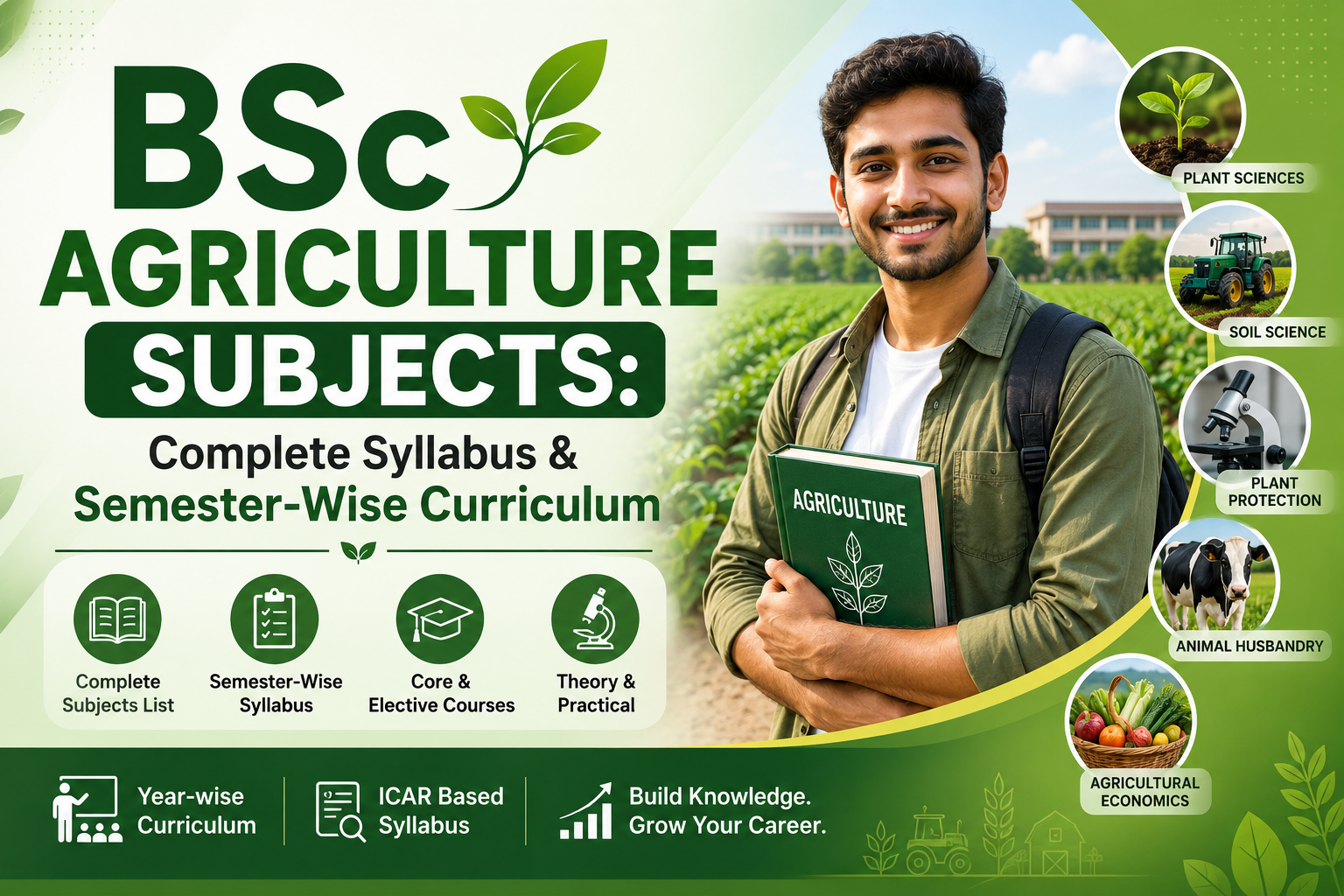
The short answer first, because that’s what most people came for. B sc agriculture subjects run across eight semesters and four years, built on the ICAR model curriculum, and they cover far more than crops. You study soil, genetics, pests, economics, farm machinery and biotechnology, with roughly 60% of the marks now tied to practical work rather than theory. The final year barely touches a classroom: it’s village postings and a mini agri-business you run yourself.
That last part surprises people. So does the fact that the B.Sc. Agriculture syllabus has been rebuilt under NEP 2020 and the ICAR Sixth Dean’s Committee, shifting hard toward hands-on training. Here’s the full year-by-year breakdown, plus what the practical components actually involve.
Key takeaways
- Eight semesters, four years, ICAR-standardised, so the core is broadly the same whether you study in Punjab or West Bengal.
- The B.Sc. Agriculture course curriculum now runs a 60:40 practical-to-theory ratio under the latest ICAR/NEP framework.
- Every major subject has a paired theory and practical component. You don’t just read about grafting; you graft.
- Years one and two build fundamentals. Years three and four go specialised, then almost fully practical.
- The final year is RAWE (a 20-week village stay) plus ELP (running a real agri-enterprise). This is the part employers ask about.
How the BSc Agriculture syllabus is structured
Think of the four years as a slope, not four equal blocks. You start with basic science and Indian agricultural heritage, climb into crop production and protection, then into management and entrepreneurship, and finish almost entirely in the field.
The ICAR framework keeps the skeleton consistent across universities. Course titles shift a little; one college’s “Fundamentals of Agronomy” is another’s “Principles of Crop Production”, but the themes and credit structure hold. That consistency is deliberate, and it’s why an ICAR-aligned degree travels well to PG entrance exams and government recruitment alike.
One structural detail that catches PCM students off guard: if you came in without Biology, expect a remedial botany or plant-science module in semester one. It’s a bridge, not a barrier.
Semester-wise subjects
First year (Semesters I & II)
Foundations. You meet the basic sciences and the discipline itself.
- Fundamentals of Agronomy, Soil Science, Genetics, and Plant Biochemistry
- Introductory Biology / remedial botany for maths-stream students
- Agricultural Meteorology, Introduction to Forestry
- Comprehension and communication skills, plus basic agricultural statistics
- Indian agricultural heritage is more interesting than it sounds, and it frames everything after it
Second year (Semesters III & IV)
This is where it gets technical. The bsc agriculture semester wise subjects here move into how crops are actually grown and defended.
- Crop Production (Kharif and Rabi crops), Agronomy of field crops
- Entomology (insect pests) and Plant Pathology (crop diseases)
- Genetics and Plant Breeding, Agricultural Microbiology
- Horticulture – fruit, vegetable and ornamental crops
- Soil fertility, nutrient management and agricultural finance
Third year (Semesters V & VI)
Management, protection and enterprise thinking take over.
- Integrated Pest Management and Pests of Stored Grain
- Farm Management, Production Economics, Agribusiness Management
- Seed Production and Technology, Post-Harvest Management
- Renewable energy, protected cultivation, and often an educational tour
- Elective choices open up here: Mushroom Cultivation, Apiculture, Sericulture, Organic Farming
Fourth year (Semesters VII & VIII)
Almost no lectures. This is the year that makes the degree professional.
- Semester VII – RAWE: the Rural Agricultural Work Experience. A roughly 20-week village and farm attachment where you live near farmers, diagnose real problems and work with farm families. ICAR pays a stipend during it.
- Semester VIII – ELP: the Experiential Learning Programme. You run a mini agri-enterprise end to end, from production to marketing, often something like commercial horticulture or bio-fertiliser production. Attendance rules are strict; enterprises don’t pause for holidays.
Theory vs practical: the weightage that changed
|
Component |
Older ICAR curriculum |
Current (VI Dean’s / NEP 2020) |
|
Practical-to-theory split |
Roughly 40:60 |
Around 60:40 |
|
Final-year focus |
Some internship |
Full RAWE + ELP year |
|
Exit flexibility |
Single degree exit |
Multiple exit (certificate/diploma/degree) |
|
Skill modules |
Limited |
Mandatory skill-based modules |
|
New-tech content |
Sparse |
Agri-informatics, drones, climate-smart farming |
What the practical training actually gives you
Employers in this sector don’t hire on marksheets alone; they hire on whether you’ve handled a real farm problem. That’s the whole logic behind RAWE and ELP.
RAWE puts you in a village for the better part of a semester. You’re not observing — you’re diagnosing crop issues, advising farm families, seeing why a “textbook” recommendation fails on real soil. Students consistently call it the part of the degree that changed how they think.
ELP then flips you from student to operator. Running a mini-enterprise, even a small one, teaches costing, marketing and failure in a way no exam can. When an agri-business recruiter or an IBPS AFO interview panel asks what you’ve actually done, this is the answer that lands.
Common challenges with the curriculum
- The practical load is heavy and non-negotiable. Students who pictured a lecture-hall science degree find the fieldwork exhausting; the ones who came for the fieldwork thrive.
- Syllabi differ in the details between universities, so notes and PDFs from one college won’t map perfectly onto another’s exams. Use your own university’s official syllabus, not a generic download.
- The elective choice in year three quietly shapes your career. Picking Apiculture or Organic Farming on a whim, then wanting an agri-tech job, creates a mismatch you’ll feel at placement.
- RAWE’s village posting can be logistically demanding. Plan for it rather than being surprised by it in the final year.
Expert tips
- Download your target university’s syllabus PDF before admission, not after. It tells you the elective spread and the tech content, which is where good programmes separate from box-tickers.
- Treat RAWE and ELP as your CV, not a formality. Keep a proper daily field log — recruiters and PG interviewers ask for specifics, and a real record beats a vague memory.
- If PG research is the plan, weight your attention toward Genetics, Plant Breeding and Soil Science, and start ICAR JRF/SRF prep from year three rather than year four.
- Check whether your university has actually adopted the VI Dean’s Committee framework. Some are mid-transition, and the practical ratio and multiple-exit options depend on it.
Studying agriculture at Adamas University, Kolkata
For students comparing the syllabus across agriculture colleges in West Bengal, the School of Smart Agriculture at Adamas University runs its B.Sc. (Hons.) Agriculture on the ICAR model, with the practical year built around RAWE and ELP on its Barasat campus near Kolkata. The distinguishing bit is where the “smart” comes in — precision farming, agri-informatics and sustainability modules sit alongside the classical agronomy and plant-breeding core, matching the direction ICAR’s newer curriculum is pushing. Admission runs through multiple routes on standard eligibility, and scholarships for 2026-27 are linked to entrance performance.
Conclusion
The BSc Agriculture syllabus is best understood as a slow handover from classroom to field. Four years, eight semesters, a consistent ICAR core, and a final year that turns theory into village work and a real enterprise. The subject matter, but the practical training, is what the degree is actually selling, and what employers actually buy.
If you’re weighing up the curriculum at agriculture colleges in West Bengal for the 2026 session, apply to Adamas University or call 1800-419-7423 to ask the admissions team how the School of Smart Agriculture runs its practical year before this intake closes.
FAQs
How many subjects are there in each semester of the BSc Agriculture?
Typically, 8 to 11 courses per semester, each usually carrying both a theory and a practical component. The exact count varies by university and by which year you’re in; later semesters lean heavier on practicals.
Is Biology compulsory to study the BSc Agriculture syllabus?
No. Students from both the PCB and PCM streams can take the course. Maths-stream students without Biology usually complete a remedial botany or plant-science module in the first semester to level up.
What is RAWE in the BSc Agriculture curriculum?
RAWE is the Rural Agricultural Work Experience, a roughly 20-week attachment in the final year where students live and work in villages and on farms. It carries a stipend from ICAR and is where most of the degree’s real-world learning happens.
Is the BSc Agriculture syllabus the same at every university?
The core is broadly consistent because it follows the ICAR model curriculum, but course titles, electives and the exact credit split differ between state, central and private universities. Always study your own institution’s official syllabus.
Which subjects matter most for higher studies after a BSc Agriculture?
For ICAR JRF/SRF and M.Sc entrance, Genetics and Plant Breeding, Soil Science and Agronomy carry the most weight. Students aiming at agri-business lean on the farm management and economics courses in year three.
Visited 2156 times, 2 Visits today

