

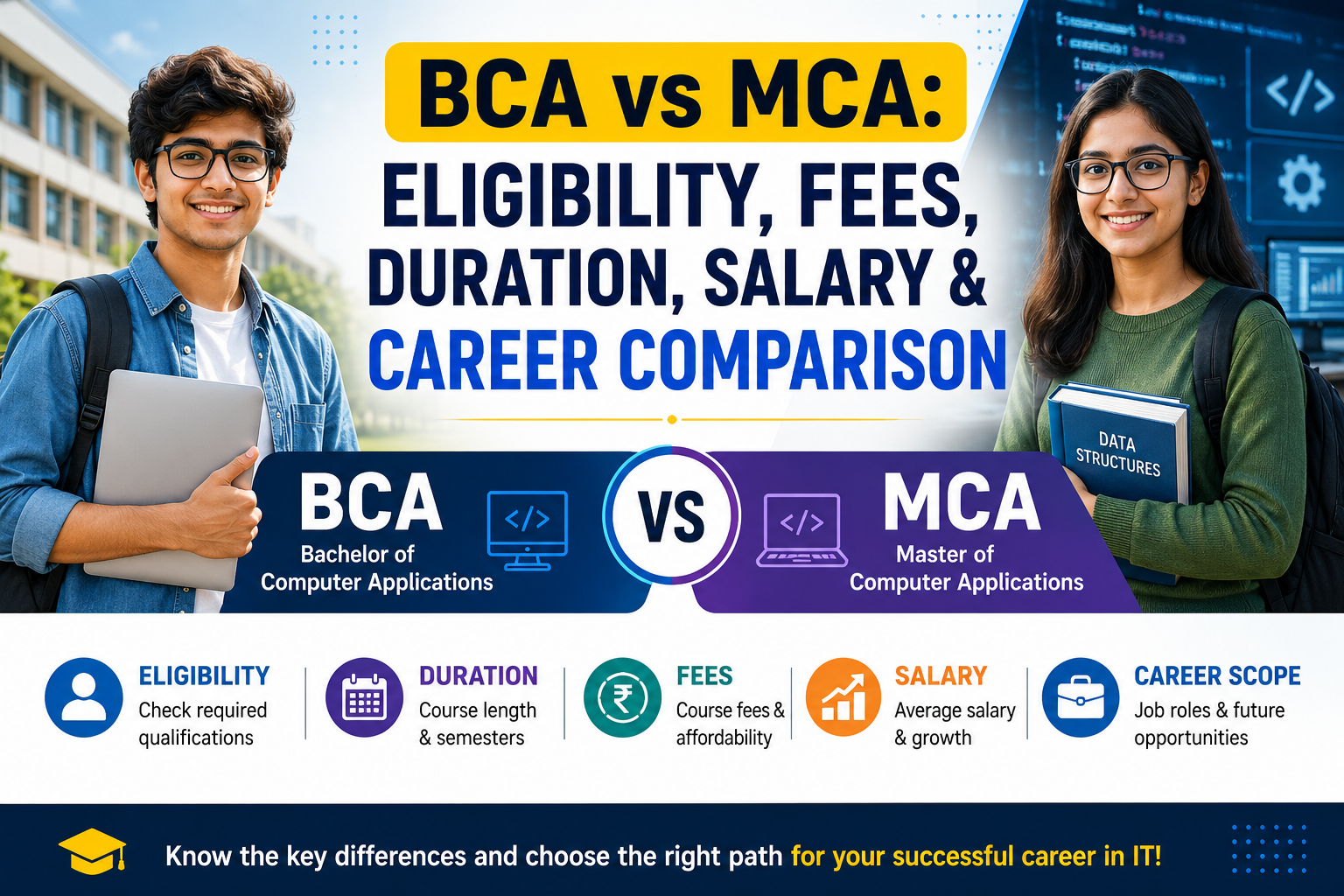
BCA and MCA aren’t rivals. They’re a sequence.
BCA is the three-year undergraduate degree you take after Class 12. MCA is a two-year postgraduate degree that you take after it. Asking which is better is a bit like asking whether Class 10 beats Class 12. The real question is whether you stop after the BCA course and start earning, or spend two more years and enter at a different level.
Money makes the case plain. BCA freshers start around ₹3–8 LPA. MCA graduates average ₹7–10 LPA, with experienced professionals crossing ₹20 LPA. Below: eligibility, duration, fees, salary and career paths for each, separately.
Key takeaways
- BCA: 3 years after 10+2, any stream, 45–50%. Four years under the NEP honours route.
- MCA: 2 years after graduation. UGC cut it from three years to two in 2020; most blogs still get this wrong.
- Fees overlap more than people assume: BCA ₹10,000–3 lakh a year, MCA ₹20,000–2 lakh.
- Jobs after BCA : developer, web developer, data analyst. MCA is what unlocks architecture and senior engineering roles.
- You don’t need a BCA to do an MCA. BSc and B.Tech graduates qualify; Class 12 Maths is the usual hard requirement.
BCA vs MCA at a glance
|
BCA |
MCA |
|
|
Level |
Undergraduate |
Postgraduate |
|
Duration |
3 years (4 under NEP honours) |
2 years |
|
Eligibility |
10+2, any stream, 45–50% |
Graduation with Maths, ~50% |
|
Entrance |
Merit or university test |
CUET PG, NIMCET, TANCET, university test |
|
Annual fees |
₹10,000–3,00,000 |
₹20,000–2,00,000 |
|
Fresher salary |
₹3–8 LPA |
₹4–12 LPA (avg 7–10) |
|
Entry roles |
Web developer, junior developer, data analyst |
Software engineer, system analyst, cloud engineer |
Eligibility: who can apply
For BCA, you need 10+2 from a recognised board with 45–50% aggregate. Any stream, Science, Commerce or Arts. Most good universities prefer Mathematics or Computer Science as a Class 12 subject, and some insist on it. A few run a foundation module for students who arrive without it.
For MCA, you need a bachelor’s degree with roughly 50%. BCA is the natural feeder, but BSc (IT/Computer Science), B.Tech and other graduates qualify at most universities. The condition that catches people is Mathematics, usually required at the Class 12 or graduation level. Candidates from non-computing backgrounds may need a bridge module in semester one.
Admission routes differ, too. BCA is mostly merit-based or via a university test. MCA runs through CUET PG, NIMCET, TANCET or an institutional exam, depending on where you apply.
Duration: three years, then two
BCA runs for three years across six semesters. Under NEP 2020, many universities now offer a four-year honours-with-research version with multiple exit points, a certificate at one year, diploma at two, degree at three. That structure also creates a smoother bridge into postgraduate study abroad, which the three-year version never had.
MCA is two years, four semesters. This is the detail most sources still get wrong: UGC reduced it from three years to two back in 2020. If an article tells you three, it’s outdated, and the error distorts the entire cost calculation.
Total run for both: five years. Same as an integrated law degree, one year more than B.Tech.
Fees: what each actually costs
|
College type |
BCA (per year) |
MCA (per year) |
|
Government / aided |
₹10,000–40,000 |
₹20,000–50,000 |
|
Private university |
₹80,000–3,00,000 |
₹60,000–2,00,000 |
|
Typical mid-range |
₹60,000–1,20,000 |
₹50,000–1,00,000 |
Two things worth noticing. First, MCA is often cheaper per year than BCA at private universities, which surprises people, postgraduate programmes carry lower headcounts and less marketing overhead. Second, the honest number is the five-year total, not the annual fee. Model BCA plus MCA as one investment, because that’s how you’ll actually pay it.
Entrance-linked scholarships change the real figure at private universities, sometimes substantially. Compare after waivers, not on sticker price.
Salary: what the gap really looks like
BCA freshers land ₹3–8 LPA. The spread is wide because it tracks skills, not the degree, a graduate with a project portfolio and cloud certifications sits at the top of that band, one with neither sits at the bottom.
MCA graduates average ₹7–10 LPA, with freshers at ₹4–8 LPA and experienced professionals crossing ₹20 LPA. The premium comes from role access rather than the certificate itself: MCA opens engineering and architecture positions that BCA-only candidates rarely get shortlisted for.
The caveat matters. These are national averages across cities, roles and company types. A Kolkata support role and a Bengaluru product role live at opposite ends of the same number, and skills move you further within a band than the degree moves you between bands.
Career paths: after BCA and after MCA
After BCA: software developer, web developer, data analyst, system administrator, QA engineer. With a specialisation, cyber security, data analytics, and gaming, those tracks narrow and pay better. It’s a genuine three-year route into IT employment, which is the whole point of the degree.
After MCA: software engineer, system analyst, cloud engineer, data scientist, IT consultant. MCA is broadly treated as B.Tech-equivalent for hiring and for government job eligibility, which is precisely why BCA graduates return for it. Product companies hiring architects, government IT posts specifying a PG qualification, and teaching positions all filter on it.
The ceiling is the honest reason people go back. Two or three years into a junior role, promotions start going to postgraduates and engineering backgrounds, and the limit stops being theoretical.
Where students get this wrong
- Treating it as either/or. Most MCA students did a BCA first. The real decision is when, straight through, or after work experience.
- Assuming MCA is still three years. UGC changed it in 2020, and the outdated number wrecks the cost-benefit maths.
- Ignoring the Maths requirement. A BCA student who dodged maths modules can hit a wall at MCA admission.
- Chasing the cheapest BCA colleges without checking placements. A ₹40,000 degree leading nowhere costs more than a ₹1.2-lakh one that places you.
- Doing an MCA to postpone job-hunting. Recruiters can tell the difference between a strategic PG and a hiding place.
How to decide, step by step
- Name your target role honestly. Web developer or junior analyst? BCA suffices. Architect, data scientist, government IT officer? You’ll need the MCA eventually.
- Check your Class 12 Maths status now. It determines whether MCA stays open.
- Model total cost across five years, not annual fees.
- Look at placement data by degree, not by college. The gap between a university’s BCA and MCA outcomes tells you what the PG is worth there.
- If you’re mid-BCA, decide in semester five, that’s when CUET PG or NIMCET prep needs to begin.
- Consider working first. Two years of industry experience make MCA coursework stand out, and some employers part-fund it.
Before you decide
- Skills beat a degree tier at the entry level. A BCA graduate with a portfolio out-hires an MCA graduate without one. The degree opens the interview; it doesn’t win it.
- If you’re doing a BCA now, treat the specialisation seriously. Data analytics, cybersecurity and gaming tracks are what recruiters filter on.
- Verify UGC-DEB approval for any online option at either level. An unapproved degree fails government eligibility checks at the worst moment.
- Lateral entry into MCA’s second year exists at several universities, which shortens the detour for eligible candidates.
Studying computer applications at Adamas University, Kolkata
For students comparing BCA colleges in Kolkata and West Bengal, Adamas University runs both ends of this pathway on one Barasat campus, which matters practically, since continuing from BCA into MCA at the same university removes an admission cycle from your plans. The BCA follows the NEP four-year structure with multiple exit points and tracks, including Gaming & Animation and BFSI; the MCA runs the standard two-year format. Admission works on standard eligibility through multiple routes, and scholarships for 2026-27 are tied to entrance performance rather than board marks alone.
Conclusion
Stop framing this as BCA versus MCA. Frame it as: do I enter the industry at 21 and possibly return at 25, or plan the five-year run now? Both answers are defensible. The one that isn’t is drifting into an MCA because the job hunt got hard, or skipping it while quietly wanting the roles it gates.
If you’re weighing up BCA or MCA admission in Kolkata for the 2026 session, apply to Adamas University or call 1800-419-7423 to talk through which entry point fits your target role before this intake closes.
FAQs
Can I do MCA without a BCA?
Yes. BSc (IT/Computer Science), B.Tech and other graduates qualify at most universities, usually with Mathematics at Class 12 or graduation level. Candidates from non-computing backgrounds may need a bridge module in the first semester.
Is MCA still a 3-year course?
No. UGC reduced MCA from three years to two in 2020. It now runs four semesters. Any source saying three years is out of date, and that error meaningfully distorts the cost comparison.
Which pays more, BCA or MCA?
MCA, on average, roughly ₹7–10 LPA against ₹3–8 LPA for BCA freshers. But averages hide a wide spread. Role, city, company type and your actual skills move the number far more than the degree label.
What are the best jobs after BCA?
Software developer, web developer, data analyst, system administrator and QA engineer are the common entry points. With a specialisation and a portfolio, cyber security and cloud roles open up. Senior architecture roles usually wait for an MCA or equivalent experience.
Should I do MCA immediately after BCA or work first?
Both work. Going straight through finishes your education by 23. Working first makes the coursework more meaningful and sometimes gets partly funded. The wrong reason to go straight through is avoiding the job market.
Visited 2155 times, 2 Visits today

