

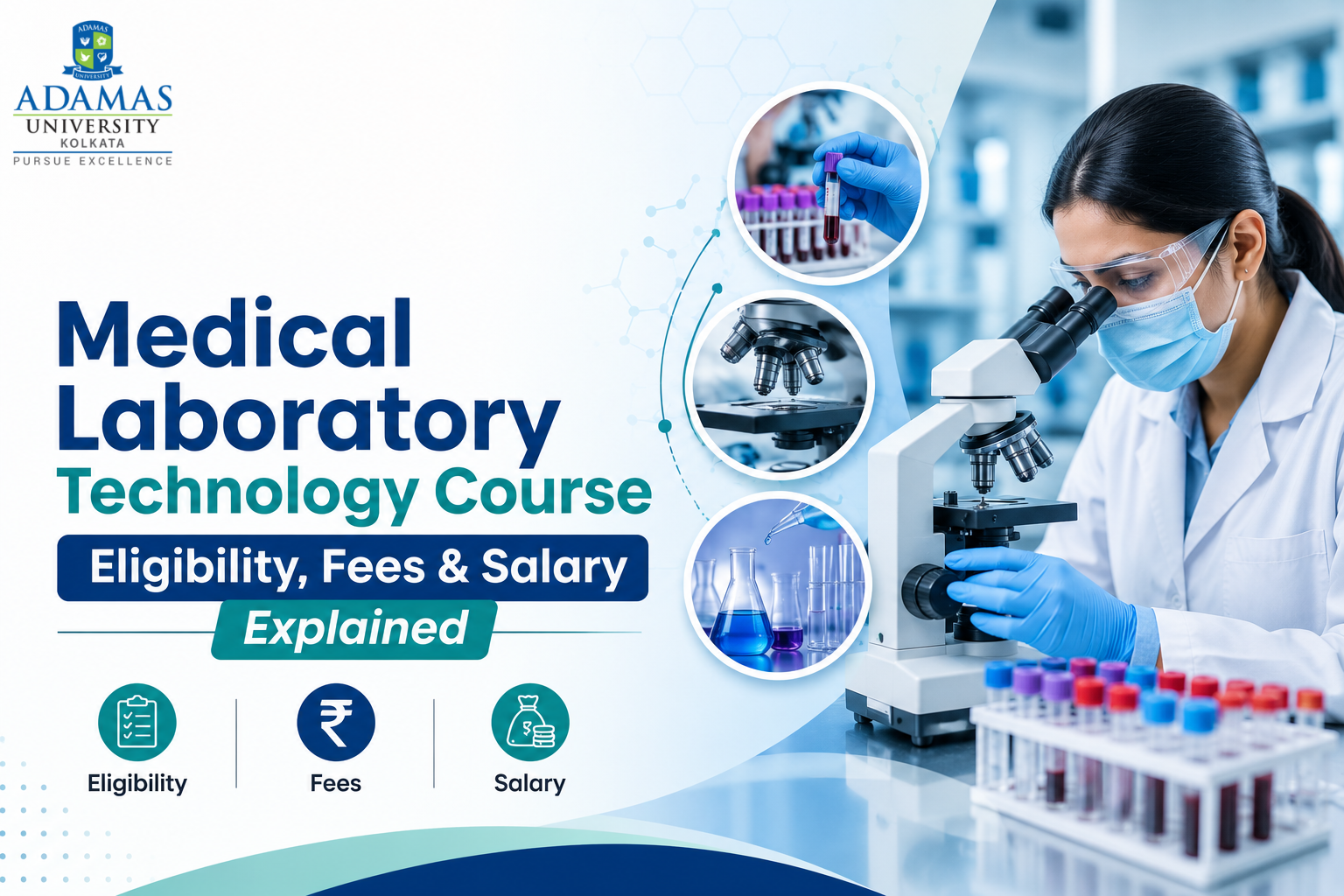
The doctor might write the prescription, but dozens of treatment decisions begin inside a lab.
Examining blood reports, analysing tissue samples, urine tests, cultures and screenings for infections, biochemical analysis and cultures – it helps doctors know what is happening inside the body and without accurate reports, it can delay diagnosis, treatment, and then can become a guessing game at what might be wrong.
That’s why the Medical Laboratory Technology Course has become a popular course of study for students considering a healthcare career, but not wanting to be a doctor. It is skill-based, practical and closely aligned with patient care. Also known as the Medical Lab Technology Course, also known as the BMLT Course, trains students to collect samples, run diagnostic tests, maintain records and operate lab equipment, to assist the doctor with reliable test results.
This course is suitable if you are not squeamish, are interested in machines, biology, chemistry, and are someone who prefers structured work. This is not a glamorous front-desk healthcare role, but it is a valuable behind-the-scenes job, and the importance of accuracy cannot be stressed enough.
Quick Pointers About the MLT Course
Here is the simple view before getting into the details:
- Course field: Allied Health Sciences
- Popular UG option: BMLT Course or B.Sc. Medical Laboratory Technology
- Ideal for: Students from the Science stream with Biology
- Core subjects: Haematology, microbiology, pathology, clinical biochemistry and immunology
- Workplaces: Hospitals, diagnostic labs, blood banks, research labs and public health labs
- Career focus: Testing, reporting, quality control, lab safety and diagnostic support
- Best fit for: Students who want a healthcare career with strong practical training
What Is Medical Laboratory Technology?
Medical Laboratory Technology is the science of testing body samples to help doctors detect, monitor and treat diseases.
A medical lab technologist works with samples such as blood, urine, stool, tissue, sputum and other body fluids. These samples are tested through manual methods, microscopes, automated machines and advanced lab systems.
A trained medical lab professional does not diagnose patients like a doctor. Their role is to produce accurate reports that help doctors make the right clinical decisions.
A Medical Lab Technology Course usually teaches students:
- Sample collection and storage
- Blood and urine testing
- Microscope handling
- Clinical biochemistry
- Microbiology cultures
- Hematology
- Pathology basics
- Lab safety and infection control
- Biomedical waste management
- Quality control in testing
- Handling automated diagnostic machines
This field needs patience. A small mistake in sample labelling, storage or machine handling can affect the final report. That is why the course gives strong importance to practical training and lab discipline.
Scope of the Medical Laboratory Technology Course
The scope of the Medical Laboratory Technology Course is steady because modern healthcare depends heavily on testing.
Doctors need lab reports for fever, infections, diabetes, thyroid, kidney function, liver function, fertility treatment, cancer care, emergency cases and preventive health checkups. Even routine annual health packages need trained lab professionals.
After completing a BMLT Course, students can work in:
- Hospital laboratories
- Private diagnostic chains
- Pathology labs
- Blood banks
- Public health laboratories
- Clinical research labs
- Pharmaceutical labs
- Biotechnology labs
- Academic laboratories
- Diagnostic equipment companies
Students can also go for higher studies in areas like medical laboratory technology, microbiology, clinical biochemistry, molecular diagnostics, pathology-related programs or public health.
The field is also growing because people are becoming more aware of preventive testing. Many patients now get tests done before a health issue becomes serious. This has increased the need for skilled lab professionals across cities and smaller towns.
MLT Course Eligibility
For most undergraduate-level programs, students need to complete 10+2 or an equivalent qualification from a recognised board.
The usual eligibility for an MLT Course is:
- 10+2 or equivalent from a recognised board
- Science stream
- Physics, Chemistry and Biology as main subjects
- Minimum marks are usually around 50%, depending on the university
- Admission through merit or an entrance process, based on the institution
Students should always check the official eligibility rules of the university before applying. Some institutions may have their own admission process, entrance test or counselling round.
Medical Lab Technology Course Fees
The fees for a Medical Lab Technology Course vary depending on the type of institution, city, course duration, lab infrastructure and practical training model.
A general fee idea looks like this:
|
Course Type |
Approximate Fee Range |
|
Diploma in MLT |
₹30,000 to ₹3 lakh |
|
UG MLT / BMLT Course |
₹1 lakh to ₹6 lakh |
|
PG MLT Course |
₹1 lakh to ₹4 lakh |
Private universities may charge more because lab infrastructure, machines, practical sessions, faculty support and internship exposure add to the overall cost.
Before choosing a college, students should check what the fee includes. Look for tuition fee, examination fee, lab fee, registration charges, internship support and hostel fee if needed.
A cheaper course is not always better. In a lab-based healthcare field, practical exposure matters a lot.
Job Roles & Expected Salary After a BMLT Course
A BMLT Course can lead to different roles in hospitals, diagnostic labs and research-based setups.
|
Job Role |
What the Role Involves |
Expected Salary Range |
|
Medical Lab Technologist |
Runs lab tests and maintains diagnostic reports |
₹2.5 to ₹4.5 LPA |
|
Lab Technician |
Handles routine sample testing and lab work |
₹2 to ₹3 LPA |
|
Pathology Lab Assistant |
Supports pathology testing and sample preparation |
₹2 to ₹3.5 LPA |
|
Blood Bank Technician |
Works on blood collection, storage and typing |
₹2.5 to ₹4 LPA |
|
Microbiology Lab Technician |
Handles cultures and infection-related tests |
₹2.5 to ₹4.5 LPA |
|
Technical Executive |
Supports lab operations and diagnostic equipment processes |
₹3.5 to ₹5 LPA |
Salary depends on the city, employer, skills, internship experience and specialisation. Freshers may start with basic lab roles, but growth improves with experience.
Larger hospitals, reputed diagnostic chains, research labs and metro cities usually offer better salary growth. Students who learn advanced testing methods, quality control and automated machines can build stronger career paths.
B.Sc. Medical Laboratory Technology at Adamas University
Adamas University offers a B.Sc. Medical Laboratory Technology under the School of Health and Medical Sciences. The program is designed for students who want structured academic learning along with practical lab training.
The eligibility is 10+2 or equivalent in the Science group with Physics, Chemistry and Biology as main subjects and a minimum 50% aggregate.
The course focuses on routine and advanced diagnostic lab procedures, automated machines, quality control, interpretation of lab investigations and communication with healthcare teams. This makes it a strong option for students who want a lab-based healthcare career in Kolkata and eastern India.
Conclusion
The Medical Laboratory Technology Course is a practical healthcare path for students who want to work close to patient care through diagnostics.
It offers clear eligibility, steady scope, useful job roles and space for long-term growth through specialisation. Students comparing an MLT Course, Medical Lab Technology Course or BMLT Course should not look only at the fee. They should also check lab facilities, faculty, internships, course duration and career support.
To study B.Sc. Medical Laboratory Technology in Kolkata, students can explore the program at Adamas University and apply through the official admissions page.
FAQs
1. What is the difference between MLT and BMLT?
MLT means Medical Laboratory Technology. It is the broader field. BMLT usually refers to a bachelor ’s-level program in Medical Laboratory Technology.
2. Is the Medical Laboratory Technology Course good for PCB students?
Yes. The Medical Laboratory Technology Course is a good option for students with Physics, Chemistry and Biology who want a healthcare career focused on lab testing and diagnostics.
3. What is the salary after a BMLT Course?
Freshers can usually expect around ₹2 LPA to ₹4.5 LPA, depending on the job role, city, employer and practical skills. Salary improves with experience and specialisation.
4. Can MLT graduates work in hospitals?
Yes. MLT graduates can work in hospital labs, diagnostic labs, blood banks, public health labs, research labs and pharma-related lab setups.
5. Does Adamas University offer a Medical Lab Technology Course?
Yes. Adamas University offers a B.Sc. Medical Laboratory Technology under the School of Health and Medical Sciences. It is a 4-year undergraduate program for eligible Science students.
Visited 2151 times, 2 Visits today

