

A blood test, a medicine, a vaccine, a food safety report and a genetic study may look like different worlds. But all are linked by one subject: Biochemistry.
Biochemistry studies the chemical processes happening inside living organisms. In other words, it talks about how cells work, how enzymes act, how diseases form, how medicines work and how nutrition is used in the body.
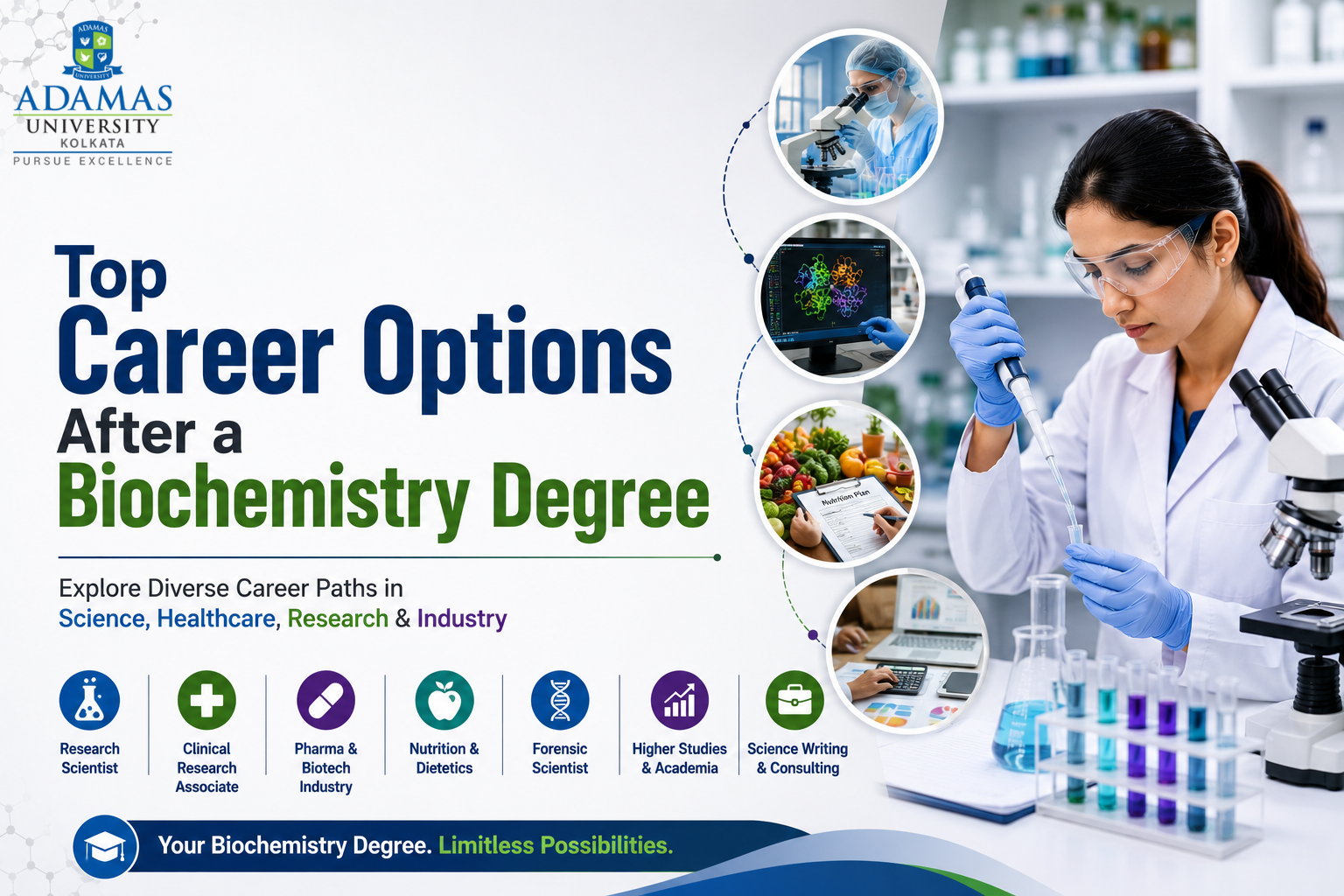
That is why a Biochemistry Degree can lead you into careers in healthcare, diagnostics, pharma, biotechnology, food science, research and academics.
Students who take a Biochemistry Course commonly love biology and chemistry together. They are inquisitive about what is happening in the body, at a molecular level. A lot of them take a BSc Biochemistry after class 12. Many of them also take an MSc Biochemistry to get better and more opportunities in the lab, research and industry.
The career roadmap may not be apparent in the first year. But with the right skills, lab exposure and specialisation, biochemistry can lead to great and fulfilling career options.
Quick Career Snapshot After Biochemistry
Here is the simple view:
- BSc Biochemistry builds the foundation in life sciences and chemistry.
- MSc Biochemistry gives deeper knowledge and better access to advanced roles.
- Career options exist in pharma, diagnostics, research, food testing, biotechnology and teaching.
- Lab skills matter as much as theory.
- Higher studies can improve growth.
- Students can work in both private and government-linked sectors.
- A Biochemistry Degree is useful for students who like research, analysis and practical science.
What Is a Biochemistry Course?
A Biochemistry Course studies the chemistry of life.
It teaches students how living systems function at the molecular level. This includes proteins, enzymes, carbohydrates, lipids, DNA, RNA, metabolism, hormones, diseases and biochemical reactions.
In simple words, biochemistry helps students understand the science behind health, medicine, food, cells and disease.
Common subjects include:
- Cell biology
- Biomolecules
- Enzymology
- Metabolism
- Molecular biology
- Genetics
- Immunology
- Clinical biochemistry
- Microbiology
- Analytical techniques
- Biostatistics
- Biotechnology basics
- Research methodology
The subject is practical by nature. Students spend time in labs learning techniques such as pipetting, sample preparation, centrifugation, chromatography, electrophoresis, spectrophotometry and biochemical analysis.
BSc Biochemistry vs MSc Biochemistry
Students often ask whether a BSc Biochemistry is enough or whether an MSc Biochemistry is needed.
The answer depends on the career goal.
|
Course |
Best For |
Career Use |
|
BSc Biochemistry |
Students starting after 12th |
Entry-level lab, quality control, research assistant and higher study options |
|
MSc Biochemistry |
Graduates who want deeper specialisation |
Better roles in research, pharma, clinical labs, teaching and advanced technical work |
A bachelor’s degree can help students enter basic roles. A master’s degree usually gives stronger opportunities in research, diagnostics, quality control, teaching and specialised industry roles.
Students interested in PhD, research scientist roles or academic careers should strongly consider postgraduate study.
Top Career Options After a Biochemistry Degree
1. Research Assistant
A research assistant is one of the most common starting roles after a Biochemistry Degree.
Students work in research labs, universities, pharma companies, biotech firms or government-funded projects. The work may include sample testing, experiment support, data recording, report writing and lab maintenance.
This role is good for students who enjoy experiments and want to build a research career.
2. Quality Control Analyst
Quality control is a strong career option in pharma, food, biotech and healthcare product companies.
A quality control analyst checks whether products meet required safety and quality standards. The work may involve raw material testing, batch testing, documentation, equipment handling and compliance support.
Students with strong lab discipline can do well in this role.
3. Clinical Laboratory Scientist
Clinical labs need trained professionals who understand biochemical testing.
A clinical laboratory scientist or lab analyst may work with blood, urine or other patient samples. They support testing related to liver function, kidney function, blood sugar, hormones, enzymes and other health markers.
This role connects biochemistry directly with patient care.
4. Pharmaceutical Executive
Pharma companies need biochemistry graduates for research, production support, quality assurance, documentation, regulatory support and product testing.
A student with MSc Biochemistry may get better access to technical roles in pharma. Over time, this path can lead to quality assurance, R&D or regulatory affairs.
5. Biotechnologist
Biochemistry and biotechnology are closely linked.
Biotechnologists work with biological systems to develop products or processes in healthcare, agriculture, the environment, food and industry. A biochemistry student can move into this field by building skills in molecular biology, cell culture, genetics and bioprocessing.
This option is useful for students who want applied science careers.
- Food Safety and Quality Executive
Food companies require smart professionals who can relate nutrients, enzymes, and microbes to understand contamination and testing.
A food quality executive may operate at food company labs, product plants or in quality departments. The role involves checking product quality, safety, shelf life, hygiene, and general compliance.
Students interested in the world of food can explore this career after a Biochemistry Course.
- Clinical Research Associate
This is yet another of the popular areas in clinical research.
A clinical research associate essentially helps to manage the overall project, assist in clinical trial planning and documentation, helps in site coordination, protocol compliance, and data quality.
This role, with a good dose of science involved also requires communication skills and attention to detail.
Students can pursue extra training or certification in clinical research before opting for this field.
- Medical Writer or Scientific Content Writer
Not every biochemistry graduate has to stay in the lab.
Any student who has a passion for science as well as the pen must check out medical writing, scientific content, writing research summaries, health care communication, and pharma documentation.
This role can be an attractive option for students who can explain the biggest science in words that the layman understands.
9. Teaching and Academics
Students who enjoy explaining concepts can move into teaching.
After MSc Biochemistry, students may teach at schools, coaching institutes or colleges, depending on eligibility. For university-level teaching and research, a PhD and required qualifications may be needed.
Academics is a good path for students who like mentoring, research and long-term subject depth.
Jobs and Salary After Biochemistry Degree
Salary depends on qualification, city, skills, employer and experience.
|
Job Role |
Suitable Qualification |
Approximate Salary Range |
|
Lab Technician |
BSc Biochemistry |
₹2.5 to ₹3.5 LPA |
|
Research Assistant |
BSc or MSc Biochemistry |
₹3 to ₹5 LPA |
|
Quality Control Analyst |
BSc or MSc Biochemistry |
₹3 to ₹5.5 LPA |
|
Clinical Lab Scientist |
BSc or MSc Biochemistry |
₹2.5 to ₹5 LPA |
|
Clinical Research Associate |
MSc Biochemistry preferred |
₹4 to ₹6.5 LPA |
|
Biotechnologist |
BSc or MSc Biochemistry with relevant skills |
₹3.5 to ₹6 LPA |
|
Medical Writer |
BSc or MSc Biochemistry |
₹3.5 to ₹6 LPA |
|
Research Scientist |
MSc, PhD preferred |
₹5 to ₹9 LPA or more |
Freshers should focus first on building skills. In biochemistry, growth improves with lab accuracy, technical training, higher studies and hands-on experience.
Skills Needed for a Good Biochemistry Career
A degree gives the base. Skills build a career.
Students should focus on:
- Lab safety
- Analytical thinking
- Scientific writing
- Data handling
- Instrument knowledge
- Sample testing
- Documentation
- Research reading
- Communication skills
- Basic statistics
- Problem-solving
Biochemistry rewards students who are patient. Experiments may fail. Reports need accuracy. Results need careful interpretation. This field suits students who can work with detail.
Why Choose Adamas University for Biochemistry Degree
Adamas University offers BSc Biochemistry and MSc Biochemistry under the School of Life Science and Biotechnology.
The university lists BSc Biochemistry as a 4-year program with an exit option after 3 years as per NEP guidelines. It also offers MSc Biochemistry as a 2-year postgraduate program for students who want deeper study in the subject.
The biochemistry program focuses on basic and applied biochemistry, modern tools and techniques, research thinking and allied life science fields. For students looking for a Biochemistry Degree in Kolkata, Adamas University can be considered for its structured course pathway from undergraduate to postgraduate study.
Students can check the latest eligibility, fee details and admission process on the official Adamas University website.
Conclusion
If you enjoy biology, chemistry, and lab work and research-based thinking, this is the best bet.
After completing a BSc Biochemistry, take up entry-level laboratory work, quality or research assistant jobs. After completing MSc Biochemistry, seek better opportunities in pharma, diagnostics, biotechnologies, research, clinical trials, food quality and safety and even into teaching.
“What to choose goes by choice of student” naturally; some will do lab research, pharma jobs, move into jobs in clinical research, and into write-ups and teaching and beyond into R&D.
Students want to build careers for themselves; they should check the Biochemistry Course options at Adamas University and apply from the official website.
FAQs
- What are the best career options after a Biochemistry Degree?
- Research assistant;
- Quality Controller;
- Clinical Lab Scientist;
- Pharmaceutical executive;
- Biotechnologist;
- Clinical research associate;
- Food quality executive;
- Medical writer;
- teacher.
- Is a BSc Biochemistry good for a career?
BSc Biochemistry is good. Moving forward to MSc Biochemistry opens better pathways.
Entry-level laboratory work, quality, research support, higher studies, etc. are options. Students who choose the next level with MSc Biochemistry will have access to better technical opportunities and R&D places.
- What can students do after an MSc in Biochemistry?
MSc Biochemistry is solid. Search for places in the pharma field, diagnostic, biotech, in the clinical research, food testing places, work in research labs, teach, or pursue a PhD.
- What is the salary after the Biochemistry Course?
Expect as a fresher, maybe about 2.5 LPA to 5 LPA, depending on the place of work and type of work. Choose advanced roles after MSc or PhD, or with experience and salary reaches good levels from there.
- Does Adamas University offer Biochemistry courses?
Yes. Bachelor’s and Master about biochemistry in the School of Life Science and Bio Technology.
Visited 2185 times, 2 Visits today

