

Most of us will consult an eye doctor only when our vision starts getting blurry, our spectacles aren’t working, or prolonged screen time has begun to give us regular headaches.
But eye care is not just about giving out spectacles. There’s vision testing, guidance for contact lenses, screening for eye disease, low vision assessment, binocular vision assessment, and patient counselling. This is where an optometrist steps in.
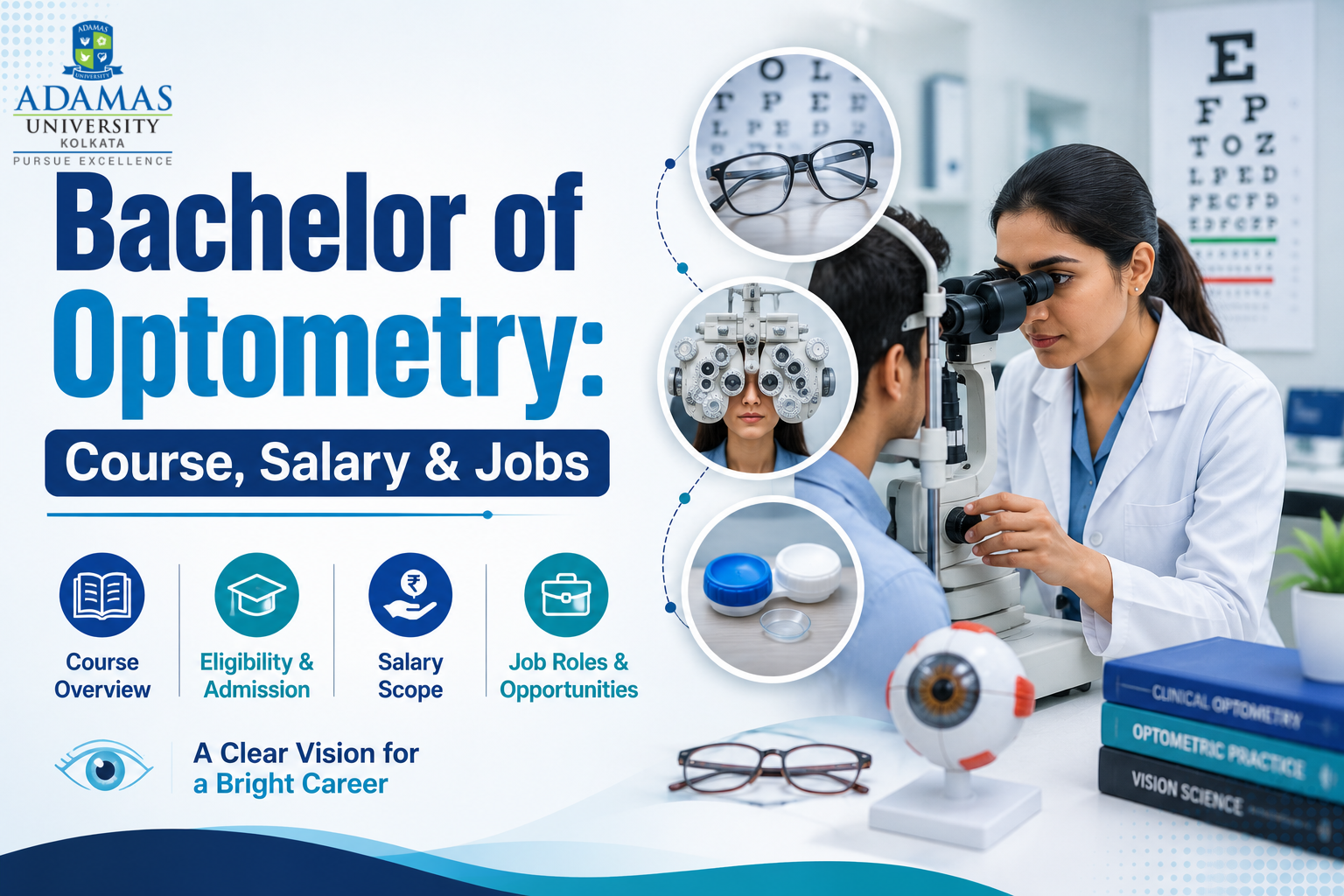
The Bachelor of Optometry is a healthcare course for students who want to make a career in the science of vision, eye care and treatment. It is an excellent option for PCB students who are keen on medical sciences but not very interested in the MBBS route.
The B Optom Course, also called the BSc Optometry, trains a student in examining vision, recognising common eye problems, assisting ophthalmologists, and serving patients’ needs with corrective lenses and basic eye care.
The field requires patience, accuracy and good clinical understanding. A tiny error in testing eyes or giving prescriptions affects a person’s daily life. And that is why the Optometry Course pays equal attention to theory and practicals.
Quick Course Snapshot for Students
Here is a simple view before getting into the full Bachelor of Optometry Course Details:
- Course name: Bachelor of Optometry
- Common names: B Optom Course, BSc Optometry
- Course level: Undergraduate allied health science course
- Duration: Usually 4 years
- Eligibility: 10+2 Science, usually with Physics, Chemistry and Biology
- Main study areas: Eye anatomy, visual science, optics, refraction, contact lenses and clinical optometry
- Career areas: Hospitals, eye clinics, optical chains, vision centres and private practice
- Best suited for: Students who like healthcare, biology, patient interaction and detailed clinical work
What is a Bachelor of Optometry?
Bachelor of Optometry is an undergraduate course that deals with eye care, vision testing and the management of common visual problems.
Optometrists are not the same as ophthalmologists. An ophthalmologist is a medical doctor who can perform eye surgeries and treat complex eye diseases. An optometrist focuses on vision testing, refraction, corrective lenses, contact lenses, screening, low vision care and basic clinical support.
In simple terms, optometrists help people see better and detect possible eye issues early.
During the course, students learn how the eye works, how vision problems develop and how to assess different visual conditions. They also learn how to use clinical equipment and interact with patients in real settings.
Bachelor of Optometry Course Details
The B Optom Course usually includes classroom learning, practical lab work, clinical training and internships.
The course covers subjects such as:
- Ocular anatomy
- Ocular physiology
- Optics
- Visual science
- Refraction
- Contact lenses
- Low vision and rehabilitation
- Binocular vision
- Ocular diseases
- Clinical optometry
- Community optometry
- Ophthalmic instruments
- Public health optometry
Students also learn how to conduct eye examinations, measure refractive errors, advise on lenses, assess visual function and support eye care professionals in clinical practice.
The practical side is very important. Students must become comfortable with patients, testing methods, instruments and case discussions. This is not a course where theory alone is enough.
A strong Optometry Course should help students build confidence in clinical observation, patient handling and accurate testing.
Eligibility for B Optom Course
The eligibility for a Bachelor of Optometry may differ slightly from one university to another. But in most cases, students need to complete 10+2 or an equivalent qualification from a recognised board.
The usual eligibility includes:
- 10+2 or equivalent from a recognised board
- Science background
- Physics, Chemistry and Biology as main subjects
- Minimum marks as required by the university
- Admission through merit, entrance test or university-level process
Students should check the official admission page of the university before applying. Some colleges may also accept PCM students, but many health science universities prefer Biology for optometry.
For students who enjoy biology and healthcare but do not want a long medical degree, the BSc Optometry route can be a practical choice.
Scope of Bachelor of Optometry in India
The scope of optometry is growing because eye care needs are increasing across age groups.
Children need vision screening. Students face screen-related eye strain. Working professionals spend long hours on laptops. Older adults need support for age-related vision problems. People with diabetes and other health conditions also need regular eye checks.
This has created a steady demand for trained optometry professionals.
After completing a Bachelor of Optometry, students can work in:
- Eye hospitals
- Multispeciality hospitals
- Optical retail chains
- Contact lens clinics
- Vision care centres
- Ophthalmology clinics
- Diagnostic eye care centres
- Community health projects
- NGOs working in eye health
- Academic and training institutions
Students can also pursue higher studies such as Master of Optometry, fellowships or specialisations in contact lens practice, low vision care, paediatric optometry, binocular vision or public health optometry.
Jobs After Bachelor of Optometry
A Bachelor of Optometry opens up different job roles in clinical and retail eye care settings.
|
Job Role |
What the Role Involves |
Approximate Salary Range |
|
Optometrist |
Conducts vision testing and supports patient eye care |
₹3 to ₹5 LPA |
|
Clinical Optometrist |
Works in hospitals or clinics with ophthalmologists |
₹3.5 to ₹6 LPA |
|
Contact Lens Specialist |
Helps patients choose and manage contact lenses |
₹3 to ₹5.5 LPA |
|
Vision Consultant |
Guides patients on lenses, eye care and visual correction |
₹3 to ₹5 LPA |
|
Optical Store Manager |
Manages optical retail operations and customer care |
₹3.5 to ₹6 LPA |
|
Low Vision Specialist |
Supports patients with reduced vision and visual aids |
₹4 to ₹7 LPA |
|
Ophthalmic Assistant |
Assists doctors in eye clinics and diagnostic testing |
₹2.5 to ₹4.5 LPA |
Freshers may begin with assistant or junior optometrist roles. Salary improves with clinical exposure, communication skills, specialization and experience.
Students who become confident with refraction, patient counselling, contact lenses and diagnostic instruments can grow faster in the field.
Bachelor of Optometry at Adamas University
Adamas University offers a Bachelor of Optometry under the School of Health and Medical Sciences in Kolkata.
The course is designed to help students study eyes, visual systems, refractive errors, contact lenses, low vision, orthoptics and clinical optometry. The university mentions hands-on training, field visits and hospital training as part of the learning approach.
For the 2026 academic year, Adamas University lists the Bachelor of Optometry as a 4-year program. The eligibility is a minimum 50% aggregate in 10+2 or equivalent from a recognised board with a Science background and Physics, Chemistry and Biology.
Conclusion
A Bachelor of Optometry is a good choice if you want to work in healthcare and not be a doctor. You have a defined course path, plus practical exposure, a tendency to interact with patients and opportunities steady in hospitals, eye clinics, optical chains and vision care centres.
The work requires accuracy, care and real compassion for helping people gain appreciation for their vision! Those comparing Bachelor of Optometry Course Details should check eligibility, fees, clinical exposure, internship support and career options before applying.
To study the Optometry Course in Kolkata, students can check out the Bachelor of Optometry programme at Adamas University. You can also apply there from the official admissions page.
FAQs
What is a Bachelor of Optometry?
Bachelor of Optometry is an allied health science undergraduate course regarding eye-care, vision testing, refraction, contact lenses and basic clinical optometry practice.
Is the B Optom Course equal to BSc Optometry?
Both are courses concerning optometry and eye care. Some offer it as Bachelor of Optometry and some as BSc Optometry. Verify the exact course structure before availing.
Who can apply for an Optometry Course after 12?
Students who have completed 10+2 in Science, generally with physics, chemistry and biology, can apply. Minimum marks depend on the university and also process for admission.
What is the salary after a Bachelor of Optometry?
As a fresher, expect around ₹3 to ₹5 LPA. This too varies depending on the kind of role, city, employer and clinical skills. More with experience and further specialisations.
Visited 2064 times, 4 Visits today

