

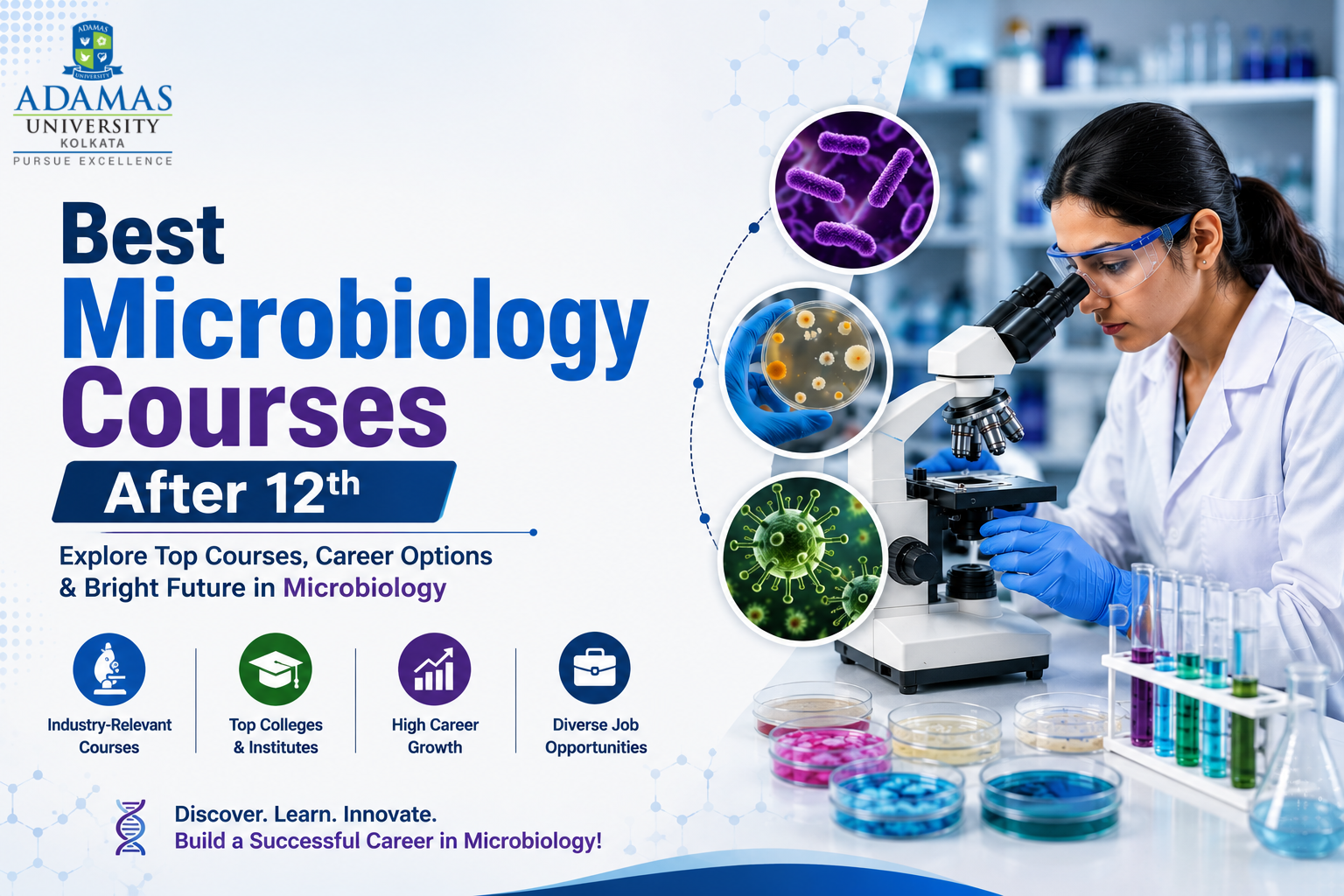
A single drop of curd, a small amount of soil, a test-tube of blood culture or a glass full of unpurified water can provide a much larger indication of life than most think.
These indications of life are studied in the science of microbiology.
Microbiology is the study of all forms of the tiniest living organisms, including but not limited to bacteria, fungi, viruses, algae and protozoa. Most often, these organisms are unseen to the naked eye; however, they all have a huge impact on all aspects of living – health, food, agriculture, pharmaceuticals/medications, water quality, the surrounding habitat of the planet and even on the production industry.
Thus, for students with a love of biological sciences and the desire not to follow the medically driven route of advancement, entering the world of Microbiology Courses after the 12th grade can open many different career possibilities.
By following this route, a student can enter the field of healthcare through laboratories, pharmaceutical companies, food manufacturers and testing, research, the field of biotechnology, the field of environmental testing and for those students wishing to pursue a career in microbiology, through their education, higher levels of education are also possible.
Points on Microbiology Courses
- UG Deg: BSc Microbiology (BSc stands for Degree done at College)
- Higher degree options: MSc in Microbiology
- Field of Studies: Life Science/Bio Science
- Ideal for: Student [PCB] attains work/loves biology
- Courses Studied: Bacteriology, Virology, Mycology, Immunology, Microbial Genetics, Industrial Microbiology.
- Work Areas: Pharmaceuticals, Food Testing, Hospital Testing; Research Laboratory Work; Quality Assurance; Biotechnology.
- Career Types: Research/Laboratory-Based; Attention to Detail.
What is Microbiology
Microbiology is the Science of the Microscopic World, including Microorganisms and Their Importance to Human Health/Disease, as Well as Food/Industry/The Environment.
Microorganisms can cause infections; they are used in making drugs/medicines; they are used in the fermentation of food; they can help maintain healthy soil; and they can provide information for developing vaccines, antibiotic drugs, and diagnostic procedures.
Microbiology is Useful/Valuable because it provides Real-World Applications by Connecting Classroom Biology with Laboratory Research & Practice.
An Excellent Microbiology Course Provides Students with Knowledge About the Growth of Microorganisms, How Microorganisms Act, and how to Isolate/Measure Microorganisms/Control Microorganisms through their Study/Use.
Class attendance will involve both Classroom Work and Laboratory Time through the use of Laboratory Equipment, i.e. Theory, Laboratory Microscopy, Culture Methods, Identification of Microbial Morphology & Characteristics, Testing Methods – Biochemical Testing Procedures/Good Laboratory Practices – AND Research Reports/Projects.
Best Microbiology Courses After 12th
It is not possible for students to apply for MSc Microbiology directly after completing Year 12. They must have an undergraduate qualification beforehand.
The following are some of the best options for students after Year 12:
- BSc Microbiology
A BSc in Microbiology is the most relevant choice for students who intend to study Microbiology. This science course studies bacteria, viruses, fungi (including parasites), microbial physiology, and immunology, as well as genetics, food-related, and clinical microbiology, industrially.
Students interested in working in research, quality control, diagnostics, or pursuing advanced degrees and who enjoy laboratory work, should consider this as a means to prepare for their future.
- BSc Biotechnology
A BSc in Biotechnology is also appropriate for students who are interested in studying Genetics, Molecular Biology, Bioprocessing, Applied Biological Sciences, and Microbiology because all of these subjects are included as part of the broader field of Biotechnology.
Students will have the opportunity to seek employment in Biotechnology firms, Research Laboratories (R&D), or in Pharmaceutical Companies.
3. BSc Biochemistry
A BSc in Biochemistry focuses on the study of the chemical activities that occur within the cells of living organisms.
This course may be appropriate for students concerned with all aspects of enzymes, metabolic processes, proteins, molecular biology, and clinical testing; such students could proceed toward microbiology, biotechnology, or through diagnostic testing at laboratory facilities to pursue their interests through research.
4. BSc Medical Laboratory Technology
The focus of this program is primarily on healthcare. Students in this program are taught how to set up, analyse and perform sample testing/diagnostic procedures safely and accurately within a healthcare and clinical laboratory environment.
- MSc Microbiology After Graduation
While this program could be considered Microbiology “related,” if students are interested in working with bacteria and other microorganisms within a “Hospital Laboratory” or “Diagnostic Setting” they can find it useful.
To attain their MSc in Microbiology, students will need to possess a Bachelor’s Degree within a microbiology-related field before applying. The MSc program offers in-depth knowledge of various fields such as medical microbiology, environmental microbiology, industrial microbiology, microbial genetics, immunology and research methodologies.
Students interested in pursuing higher-level research, education opportunities or advanced industry roles often choose the MSc program upon completion of their BSc in Microbiology.
Microbiology Course Details: Subjects and Learning Areas
The exact subject matter included on the syllabus will be different at each university; however, the vast majority of Microbiology courses utilise the same fundamental subject areas as part of their programmatic curriculum.
Students usually study:
- General microbiology
- Bacteriology
- Virology
- Mycology
- Immunology
- Microbial genetics
- Molecular biology
- Food microbiology
- Industrial microbiology
- Environmental microbiology
- Medical microbiology
- Biochemistry
- Bioinformatics basics
- Research methodology
The course will not only consist of lectures; you will also need to participate in lab work as part of the course. In order to truly learn microbiology, it is necessary for you to perform practical lab skills in addition to reading about them in textbooks.
Examples of these practical lab skills are: handling microbiological samples, preparing microscope slides, observing microorganisms under a microscope, culturing microorganisms, performing microbiological testing, and following laboratory safety procedures.
Eligibility for Microbiology Courses After 12th
The eligibility for a Microbiology Degree Course depends on the institution.
In most cases, students need:
- 10+2 or equivalent from a recognised board
- Science stream
- Biology is one of the main subjects
- Physics and Chemistry in many universities
- Minimum marks as required by the college
- Merit-based or entrance-based admission, depending on the university
Typically, students require an undergraduate-level program to study for a Master’s Degree (MSc) in microbiology, having obtained a Bachelor of Science or Bachelor of Arts degree in microbiology or a related life science field.
Before submitting your application materials, always visit the university’s website to ensure that you meet all of its most up-to-date application requirements.
Career Scope After BSc Microbiology and MSc Microbiology
The scope of microbiology will remain consistent through time as microorganisms affect numerous industries.
Hospitals require microbiological assistance to provide services for testing infections. Pharmaceutical companies employ microbiologists to assist with manufacturing products and ensuring product quality. Food manufacturers require microbiology testing services to evaluate the possibility of contamination and food safety. Research laboratories require trained individuals to evaluate data and carry out experiments. Environmental laboratories conduct testing on water, soil and waste materials.
After a BSc Microbiology or an MSc Microbiology, students can work in:
- Pharmaceutical companies
- Food and beverage companies
- Diagnostic laboratories
- Hospitals
- Biotechnology firms
- Research centres
- Environmental testing labs
- Agriculture labs
- Quality control departments
- Academic institutions
Students who complete a master’s degree usually get better access to research, teaching and specialised technical roles.
Jobs and Salary After Microbiology Courses
Freshers usually begin with junior roles. Salary improves with higher studies, lab skills, location and experience.
|
Job Role |
Main Work Area |
Approximate Salary Range |
|
Lab Technician |
Routine lab testing and sample handling |
₹2 to ₹3 LPA |
|
Junior Microbiologist |
Microbial testing and reporting |
₹2.5 to ₹4 LPA |
|
Quality Control Analyst |
Pharma, food or biotech quality testing |
₹3 to ₹5 LPA |
|
Research Assistant |
Research labs and project work |
₹3 to ₹5 LPA |
|
Food Microbiologist |
Food safety and contamination testing |
₹3 to ₹5.5 LPA |
|
Clinical Microbiology Assistant |
Hospital and diagnostic lab support |
₹2.5 to ₹4.5 LPA |
|
Microbiology Lecturer |
Teaching after a higher qualification |
₹4 to ₹7 LPA |
Students should not choose microbiology only by looking at the starting salary. It is a field where growth depends on skills, accuracy, higher studies and lab exposure.
BSc Microbiology and MSc Microbiology at Adamas University
Microbiology will be studied at Adamas University through two different programs in the School of Life Science and Biotechnology. With a focus on hands-on lab skills complemented by theory (not just memorisation!) and research comprehension as well as applied areas, our Microbiology program incorporates multiple fields of study, including (but not limited to) Industrial Microbiology, Food & Beverage Testing, Pharmaceutical applications, and Medical/Clinical Microbiology.
Adamas University offers 2 Microbiology Courses (BSc and MSc) during the 2026-27 academic year. The BSc degree requires a minimum of 55% for admission from 10 + 2 or equivalent with the appropriate subjects. The MSc degree requires a minimum of 50% from both the 10 + 2 and the Undergraduate degrees in the respective subject areas (Microbiology).
If you’re looking for structured Microbiology Courses in Kolkata today, check out the BSc and MSc programs at Adamas University or visit the official admission page for all up-to-date information.
Conclusion
Students who love biology, lab work, and solving scientific problems should consider microbiology as a subject of study.
Students who pursue a BSc in Microbiology will have the necessary foundation for a career in microbiology following the 12th standard. An MSc in Microbiology will further enhance your options for future employment in research, pharmaceutical companies, food safety organisations, health care laboratories, biotechnological companies, and teaching.
When comparing various microbiology course options, prospective students should examine the duration of the course (BSc or MSc), the availability of laboratories, course syllabi, instructors, opportunities for research, opportunities for experience through internships, and assistance with job placement.
Students interested in studying microbiology should investigate the university’s offerings of BSc and MSc degrees in microbiology and apply to study at one of the programs listed on our website.
FAQs
- What’s the best microbiology course after the 12th?
Students who want to study microbes, how to do laboratory work, the study of diseases, how to test food, and work with the industrial use of microbes should take the BSc in Microbiology after the 12th grade.
- Can I get an MSc in microbiology after the 12th?
No. To be eligible for an MSc program in microbiology, you must have completed a bachelor’s degree first. Students may apply for the MSc program after they complete their BSc in Microbiology or a related Life Science bachelor’s degree.
- What types of jobs are available for people who study microbiology?(h3)
Individuals who study microbiology have the opportunity to work as technical laboratory personnel, junior microbiologists, Quality Control (QC) Analysts, Research Assistants, Food Microbiologists, Clinical Laboratory Assistants, and Teaching Professionals, after earning master’s level qualifications.
- Is Microbiology a good career option in India?
Yes, it is! There are many different types of careers available through Microbiology in India, such as healthcare, pharmaceuticals, food safety, biotechnology, agriculture, research, and environmental testing. The most effective way to advance your career is through training at an accredited institution, as well as gaining experience from a hands-on laboratory setting.
- Does Adamas University have Courses in Microbiology?
Yes, Adamas University offers courses in Microbiology, including a BSc in Microbiology and an MSc in Microbiology, through the School of Life Sciences and Biotechnology.
Visited 2202 times, 1 Visit today

